Newsletter signup

* Email
* First Name
* Last Name
Post Code
 

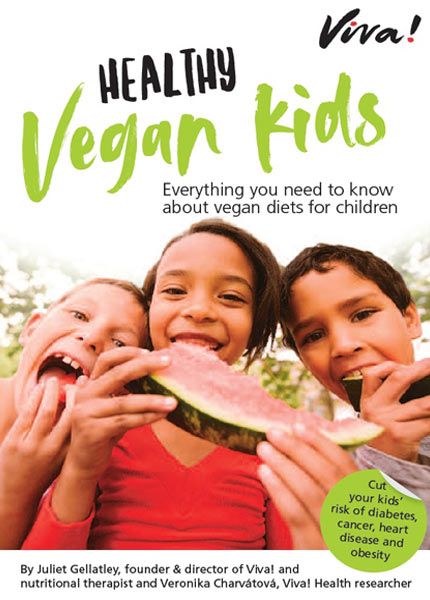
Veggie Health for Kids
Every nutrient a child needs and how to get it.
A guide for parents showing why vegetarian/vegan diets are the healthiest option for children.

World turned upside down! / What You Need and Where You Get It / How Animal Products Affect Children / How Animal Products Affect Adults / Conclusions

How Animal Products Affect Children

Allergies
The word allergy describes a bad reaction to something - it is the body's defence (immune) system leaping to protect you against what it believes is a foreign invader. Asthma (breathlessness with wheezing), eczema (red, itchy and flaky skin), rhinitis (constant runny or congested nose), hay-fever and urticaria (skin rashes) are classical allergies. Of course, in most cases this defence reaction is unnecessary and so allergies can be a sign of a ‘compromised’ immune system - it isn ’t functioning 100 per cent as it should.

Reactions can be particularly violent - and deadly - with allergies to such things as peanuts. Food ‘intolerance’ produces a less dramatic and slower reaction and may not be the result of a dodgy immune system.

The most common food allergies (or intolerances) are to foods that are eaten regularly, such as cow’s milk and wheat. A reaction to the main protein in cow’s milk (casein) is the most common allergy in childhood and affects between 4 and 75 babies in every 1000. When a baby swallows cow’s milk, bits of this protein get into his or her immune system. Excessive mucus production resulting in a constant, runny nose, blocked ears or a persistent sore throat is often the first sign of a problem with cow’s milk. More serious problems such as eczema, colic, diarrhoea, asthma and vomiting are the body’s way of trying to get rid of the invader.

A good number of scientists now believe that no whole cow’s milk at all should be given to a baby during the first year of his or her life, when the immune system is still developing.

Allergies are on the increase - but why? Saturated fat may carry some of the blame. It was found that the children of mother's who ate a lot of this fat while they were breastfeeding had an increased risk of allergies later in life.

Crohn’s Disease
Crohn's disease also appears to be on the increase and affects about 90,000 people in the UK. This debilitating, chronic (long-term) inflammation of the digestive system is, however, rare in parts of the world where people eat a low-fat, high-fibre diet. The scientific evidence is stacking up, one study pointing the finger at animal protein - meat and cow's milk. Another has discovered that a bacteria found in cattle is the same one that causes Crohn’s disease. Apparently pasteurisation of milk - heating it to 72 degrees for 15 to 25 seconds - may not kill these disease-causing bugs.

Heart Disease
The avoidance of meat is likely to reduce the risk of coronary artery disease, because meat is the major source of saturated fat...High consumption of red meat has adverse health consequences: thus vegetarian diets tend to impart health advantages.
DR WALTER C WILLETT, HARVARD MEDICAL SCHOOL, ONE OF THE WORLD’S MOST DISTINGUISHED EXPERTS ON NUTRITION.

Coronary heart disease, or CHD, results from the narrowing of the main blood vessels from the heart which is why it’s also called coronary artery disease. The problem stems from hard fatty deposits of cholesterol stiffening and clogging up the arteries. Blood supply to the heart muscles is reduced and may eventually stop completely and the result is a heart attack.

Cholesterol is a major risk factor for CHD - and saturated (mainly animal) fat makes the body produce more cholesterol. Sadly, a lot of children’s foods are stacked with saturated fat. Incredibly, autopsy studies show that fatty streaks in the arteries - the first signs of furring up - are found even in very young children!

The same things which put older people at risk of heart attacks - high cholesterol levels, overweight and high blood pressure - are the same as in young people. The WHO has become almost weary from repeating how important it is to give kids a healthy, high-fibre, low-fat diet start to life because it’s here that the problem of heart disease begins.

Dental Health
You don’t need telling that sugar is enemy number one when it comes to tooth decay (dental caries). But all kinds of foods can play a part, depending on their stickiness and nutrient content. A small plain chocolate bar eaten in one go for instance is probably less damaging than sucking on a chewy sweet for ages that literally sticks to the teeth. There are also foods that help reduce decay - rice, bread and potatoes and the less refined they are the better. So it follows that a vegetarian diet based largely on unrefined carbohydrates tends to produce fewer and smaller cavities. Fresh fruit, even though it contains fruit sugars (fructose), is less damaging than the sugar in sweets.

“A diet free of meat, fish, milk and eggs is by far the safest and one that I highly recommend.”
Emanuel Goldman, Professor of Microbiology
& Genetics.

Diabetes
Type 1 diabetes (insulin dependent diabetes mellitus or IDDM for short) is when the body produces no insulin. Type 2 (non-insulin dependent diabetes mellitus - NIDDM) is where insulin is still produced but the body becomes less sensitive to it. Insulin is a hormone which helps the body to absorb glucose (sugar) from the blood. Without it, blood sugar levels rise.

Diabetes can lead to heart disease, kidney failure and blindness. Type 2 is rising dramatically but the right kind of diet can correct or even prevent it. (See Diabetes section on page 20).

Cow’s milk in infancy may trigger type 1 diabetes by destroying the body’s ability to produce insulin.

Food Poisoning
A diet free of meat, fish, milk and eggs is by far the safest and one that I highly recommend.
EMANUEL GOLDMAN, PROFESSOR OF MICROBIOLOGY & GENETICS.

A recent government report said that an astonishing 9.5 million people in the UK get food poisoning each year and the one’s most at risk are little children under one. Eating animal products causes a staggering 95 per cent of all cases, with meat being the main culprit as the guilty bacteria thrive on rotting flesh. Poor hygiene can spread the infection to normally safe foods through contamination.

Perhaps even more worrying is the fact that one in 10 British children are carrying superbugs resistant to one or more antibiotics. Antibiotics are the last refuge when food poisoning develops into blood poisoning. There are now fewer and fewer that will work when they’re really needed - to save lives. They have been used almost on a daily basis to dose animals in factory farms in a desperate attempt to control the rampant diseases that these systems spread and the bacteria have simply become resistant.

The three main food-poisoning bacteria resistant to drugs are: Salmonella, Campylobacter and Escherichia coli (E. coli). Whilst E. coli normally lives quite happily in our guts without causing any harm, some strains cause disease. The most serious is E. coli 0157. It can stick to the gut wall and release a chemical into the bloodstream which causes kidney failure. Again, it is the young who are most at risk. This superbug is thought to be the single biggest cause of kidney failure in children and it is spread from the faeces produced by farmed animals - cattle in particular.

According to the government there are some foods you can eat to avoid the risk of food poisoning - foods that cut your risk by up to 70 per cent. Four of these are pulses, salad, fruit and rice - all everyday ingredients in a veggie diet. (See Viva! guide Stop Bugging Me for further information on food poisoning.)

Overweight and Obesity
The UK population as a whole has a serious weight problem and that includes children. Ten per cent of boys and 14.5 per cent of girls aged four to 11 years are now overweight and some children as young as five are obese.

Mild obesity in childhood is linked to increased blood pressure and higher levels of insulin and cholesterol - and it may carry on into adulthood.

There’s no mystery about the causes of obesity - diet and activity play equal parts. Meat and dairy come loaded with hefty amounts of fat while vegetarian diets contain more carbohydrates, pulses, fruits and vegetables and less fat. No surprise, then, that vegetarians are, on average, leaner than meat eaters.

Rheumatoid Arthritis
Rheumatoid Arthritis affects more than 750,000 people in the UK and one child in every thousand. Dairy products, meat and eggs can all be triggers as can corn, nuts and citrus fruits. In 1985, the case emerged of a 14 year- old girl who had been hospitalised nine times since the age of eight with painful and swollen joints. Diagnosed with juvenile rheumatoid arthritis, she was told to avoid dairy products and the swelling disappeared within a week. The arthritis returned three times in later life, each time after she’d eaten dairy products. A small piece of milk chocolate was enough to trigger it.

Toxins
Government tests show that more than 40% of all our food contains pesticide residues. Highly poisonous chemicals have polluted all the world’s oceans and they have contaminated every single sea creature. Because of this, eating fish is increasingly a risky business - and particularly oily fish such as mackerel, herring, sprats and pilchards because fat soaks up the poisons. Farmed salmon, who are largely fed on wild-caught fish, are a particular problem.

The culprits are substances called PCBs and dioxins and they can damage the immune system and affect a child’s intelligence. They can even have a gender-bending effect, producing male characteristics in females and vice versa. Produced by industrial processes, PCBs are now banned but they will hang around in the environment for decades. They contaminate particles in the sea which are eaten by small fish. The poisons concentrate in their fat and so it goes on up the food chain as little fish are eaten by bigger fish.

The problem is extremely serious and affects meat and dairy to some degree as well because of their high fat content. The European Commission (EU) guidelines on safety limits for dioxins in foods means that half of all British children under five years old could be exceeding safety levels.

Next Section


by Laura Scott (MSc Nutrition), VVF Senior Nutritionist
Editor: Tony Wardle

A guide by the Vegetarian & Vegan Foundation
Registered Charity No. 1037486

Copyright: Vegetarian & Vegan Foundation 2004.
Top Suite, 8 York Court, Wilder Street,
Bristol BS2 8QH.
Tel: 0117 970 5190. Fax: 0117 924 4646.
E: info@vegetarian.org.uk
W: www.vegetarian.org.uk


PRIVACY POLICY

Viva!, 8 York Court, Wilder Street, Bristol BS2 8QH, UK
T: 0117 944 1000 F: 0117 924 4646 E: info@viva.org.uk