Murder, She Wrote
Piggy
on a Plate / Fowl Play / Talking
Turkey / Assault and Battery / Lamb
to the Slaughter / Milky No-Way / Bulls
to you / The Slaughterhouse / Stunned / Electric
Tongs / Captive Bolt Pistol / Electrified
Water Bath / Religious Slaughter
Imagine you just landed
on Planet Earth and want to find out more about the diet of the human
race. You know that people who eat animals run a much greater risk of
dying from heart disease or cancer. They are more likely to suffer from
gall stones, obesity, diet-related diabetes, kidney stones, food poisoning
and constipation! You also know that livestock farming is a hopelessly
inefficient way of feeding people and that it causes pollution on a staggering
scale. On top of that, you have discovered that incarcerating and killing
animals causes great pain and suffering.
Coming from an advanced
planet which encourages compassion and wisdom, you obviously expect to
find that most people on earth will be vegetarians and vegans.
To your amazement,
instead you discover that each year, meat eaters in Britain consume their
own weight in animal flesh. Over the period of a lifetime it amounts
to:
5 Cattle / 20 Pigs
/ 29 Sheep / 780 Chickens / 46 Turkeys / 18 Ducks / 7 Rabbits / 1½
Geese
You may find it impossible
to believe that over 850 million animals are slaughtered for food in
Britain each year. This breaks down as:
2.3 million Cattle
19 million Sheep and Lambs
16 million Pigs
792 million Chickens
35 million Turkeys
18 million Ducks
1 million Geese
5 million Rabbits*
10,000 Deer
9,000 Goats
But how are these animals
farmed? Surely humankind must show some compassion and respect for its
fellow creatures with which it shares the Earth?
Piggy
on a Plate
Pigs are more intelligent
than dogs and used to live wild in Britain. Now they are kept locked
in prisons for meat. Pigs lived in the great forests and woods that covered
most of the UK eating beech nuts, acorns, other seeds and nuts, insects,
roots and occasionally carrion. Their snout and strong neck helped them
to grub up roots and other food. Not keen on temperature extremes, they
sought shade under the trees when they were hot and made nests from the
litter on the forest floor when they felt it was getting too nippy. All
the wild pigs in Britain were hunted to extinction in the seventeenth
century.
Instead of being free, with a right to a natural existence, more than 90 per
cent of piglets are factory farmed. In investigations of farms all over Britain,
Viva! exposed diseased, dead and dying animals.
In almost every fattening unit was glaring neglect and indifference - broken
legs, abscesses, ruptured stomachs, animals coughing with pneumonia, others
panting from meningitis, cuts and lacerations from the perforated metal on
which they are forced to live.
One farm investigated
in Yorkshire - which supplied major supermarkets - looked almost derelict,
with junk and debris everywhere and only an array of grimy windowless
sheds as the give away to what it farmed. An overpowering stench of ammonia
and faeces was overwhelming.
There was no light
inside but a cacophony of noise - a scrambling and clattering of animals
in fear. The camera lights revealed baby pigs in barren metal pens and
the noise was their feet on the bare metal floors as they charged to
get away. There were so many of then that there was no place to go or
hide.
This near darkness,
these utterly barren, sterile conditions is their home for over a month
- about one-fifth of their lives. One pig had a broken leg, others were
stunted and suffering from 'scabby pig' from which they will almost certainly
die. Some were lame, others had deformed spines.
Outside in a rusting
trailer was a pile of rotting corpses, discoloured and bloated from days
of decay were half submerged in putrid rainwater.
In the 'second stage
grower' pen, there were around 200 large pigs in an area of about 10m
by 12m. Overcrowding is typical of this industry. The pigs squealed and
screamed, biting in their desperation to be let out.
The pigs are killed
at about five months old for sausages, bacon, ham and pork.
The 'breeding stock'
- the pigs kept to produce the piglets which are killed for meat - usually
give birth in a small farrowing crate on a concrete or perforated metal
floor. Sows have strong maternal feelings and would normally spend days
building a nest of leaves or straw. In a crate they cannot do this and
so lapse into stereotyped behaviour where they repeatedly try to build
a nest in their barren cell.
The bars on the crates
stop the mother pigs from being able to move - they cannot take a step
forward or back or turn around. This causes the pregnant animals to ache
all over and many have back and leg problems.
The bars also stop them from reaching their babies when they give birth, although
the babies can reach their mother's teats to suckle. The piglets are taken
away early at about three weeks old and kept in the fattening units. Five days
after her piglets are taken away, the sow is made pregnant again and the whole
misery-go-round continues.
Fowl
Play
While red meat consumption
declines, more chickens are being eaten than ever before. Sadly, some
people believe that white meat is somehow healthy. They are wrong. Chicken
meat clots arteries, triggers cancers and is one of the biggest causes
of food poisoning in the world. And chicken farming is outright cruel.
Chicks are kept in
sheds called broiler houses where up to 100,000 birds are crammed with
less than 600cm2 of space per bird (about the space of a computer screen).
The floor is concrete and laid with sawdust, wood shavings or chopped
straw but soon becomes covered with the animals' excrement. The filth
may attract rats and flies bringing disease and because the birds are
forced to spend their entire lives standing in their own droppings, they
are in terrible pain from hock burns (burns to their feet and legs),
breast blisters and ulcerated feet. (Think how sore a little ulcer is
in your mouth and then imagine having ulcers all over your feet.Yuk.)
The windowless sheds are artificially lit for 23½ hours a day.
This deters the chicks from sleeping and instead makes them eat more.
A fat bird means more money. And money is used to excuse all sorts of
cruel and sickening things that humans do to animals and even their own
kind.
Broiler chickens are
ready for slaughter at 1.8kg live weight in 42 days, half the time it
once took. They go to death with the bodies of adult chickens and the
blue eyes and high pitched 'cheep' of little chicks. The birds grow abnormally
fast because they are fed growth promoting antibiotics and are selectively
bred to do so.
The result is that
the bones of many break under their ballooning weight and their hearts
are frequently unable to cope. The Agricultural and Food Research Council
(which supports factory farming) state that up to four fifths of broiler
chickens have broken bones, deformed feet and legs or other skeletal
defects. According to the National Farmers Union, about 72 million birds
die in broiler houses every year - before they even reach the slaughterhouse.
Talking
Turkey
At Christmas it would
be nice to think that humans show some goodwill to other creatures. And
increasing numbers do. But many British still celebrate Christmas by
killing 11 million turkeys. And yet this British "tradition" only
began in the Industrial Revolution and became widespread in the 1950's
when factory farming began.
Turkeys are still wild
in America. It makes you even sadder to think of the farmed birds when
you have seen them free in their natural environment. Wild turkeys are
actually very handsome, with black wing and tail feathers that shimmer
red-green and copper, contrasting with their white wing bars - nothing
like the all-white, broad-breasted, meat strains bred in our farms today.
They enjoy roosting in trees, but build their nests on the ground. If
they are threatened, they can fly as far as 1.6km at an amazing 88km/h
(55mph). Strange that so many people think turkeys can't fly. Seeds,
nuts, roots, tubers, grubs, grasses, legumes and sometimes small amphibians
and molluscs (snails and slugs) make up their varied diet. The turkeys
semi-wild nature means that they suffer very badly in factory farms.
Yet almost all turkeys
are intensively reared in Britain. One day old chicks (known as poults)
are either placed in large, windowless broiler sheds or in pole barns
which have natural light and ventilation. Up to 25,000 birds may be crammed
into a shed - giving only 0.27 - 0.37m² space per bird. As they
grow they can hardly move and the floor becomes putrid and stinks of
excreta. Like broiler chickens, the poor turkeys are in agony from burns
and ulcers on the feet and breasts. Professor John Webster, Head of Department
of Animal Husbandry, Bristol University says:
"One quarter of
the heavy strains of broiler chickens and turkey are in chronic pain
for one third of their lives. Given that poultry meat consumption in
the UK exceeds one million tonnes per annum, this must constitute in
both magnitude and severity, the single most severe, systematic example
of man's inhumanity to another sentient animal." (Animal Welfare:
A Cool Eye Towards Eden, Blackwell Science, 1995)
Instead of the wide
variety of food that a turkey is meant to eat, farmed birds are given
pellets of the same unnaturally high protein feed, day in, day out. A
boring, never changing diet causes frustration and stress to almost all
farm animals. Because farmed turkeys are forced to grow quickly and have
an unnaturally large breast size, many are in severe pain as their heart
and legs cannot withstand this abnormally rapid growth. About two million
baby birds die mainly from heart attacks before they reach slaughter
weight. Turkeys are never cannibals in the wild but in overcrowded, filthy
and boring conditions they may peck at each other relentlessly. Instead
of changing the conditions, some are debeaked with a red-hot blade at
5 days old.
At between 12 to 26
weeks old, the end comes for the birds and many are destined to become
the "traditional" Christmas type of dinner - oven-ready turkey.
Those worn out from constant breeding are made into processed meats,
such as turkey "ham" or "sausages".
Some of the saddest
turkeys are the ones kept for breeding. They can grow to the huge weight
of six stone and have such diseased hip joints that they can barely walk.
Doesn't it seem strange
that when people sit down for Christmas dinner, to celebrate peace and
forgiveness and all the better things in life, they do it by first cutting
something's throat and killing it? When they "coo" and "aah" and
say what a lovely turkey they're munching into, they close their eyes
to the pain and filth that was its life. And when they carve its huge
breast they probably don't even know that this great lump of flesh has
turned turkeys into freaks. We have produced a creature that can't even
mate without us doing it for them using artificial insemination. Not
a very merry Christmas for them! Turkeys are naturally "bootiful" but
what we have done to them is anything but that.
Assault
and Battery
Do chickens kept for
their eggs fare better? After all you've seen all the ads and egg boxes
that proudly declare "country fresh" and "fresh from the
countryside", "farm fresh". Surely this means hens are
free to roam the fields and woods? 'Fraid not! Unless an egg box actually
has the words FREE RANGE, it is almost certain that the eggs are from
battery hens. (In 1998 Marks & Spencer stopped selling battery eggs
and only sell free range; a positive move that came about from public
pressure against the cage system.) However around 85 per cent of Britain's
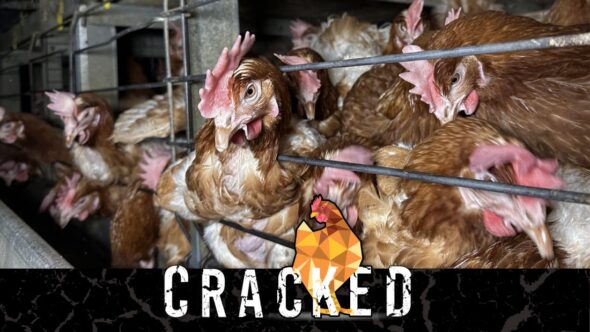
eggs are produced on battery farms, where the hens are squashed together
in small cages. They can never spread their wings, scratch in the earth,
perch or make a nest, dust-bathe, search for food that is tasty and natural,
or even walk or run.
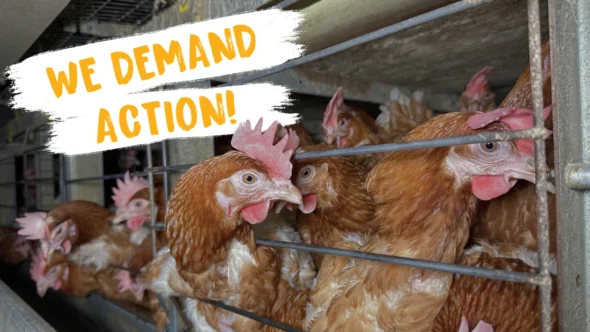
Instead, five hens
are packed into a cage of only 45 x 50cm. (slightly bigger than your
average microwave oven) and are never allowed out again until they are
taken for slaughter.
The average wing span
of a hen is 76cm - so movement and natural behaviour is severely restricted.
Thousands of cages are stacked into windowless sheds - with artificial
lighting for about 17 hours a day to promote egg laying. Up to 30,000
birds are packed in these sheds and they are all fed, watered and their
eggs collected by an automatic system. When a hen lays an egg, it rolls
onto a conveyor belt and is taken away to be boxed. Birds of 18 weeks
old are put into these cages and are not removed until they are 18 months
to two years old, when they are killed. Try to imagine the frustration,
the boredom, the anger that this system creates. Hens in more natural
conditions will often live for 7 years - sometimes much more. Slaughtered
battery hens are processed into soups, baby foods, stock cubes, school
dinners or used in the restaurant trade.
And what of the male
chicks? Because battery hens are bred to be lean, to eat little and lay
a lot, 40 million male day old chicks are killed every year - too skinny
for meat, unable to lay. Their bodies are used as fertilizer or as feed
for farm animals.
Hens in the wild lay
only 20 eggs a year, which will mostly have been fertilised by a cockerel
and will hatch. There are no cockerels in battery sheds so all eggs are
infertile. The battery hen has been bred to produce an unbelievable 300
eggs a year - nearly one a day. However, this breeding has not stripped
them of their instincts and desires. Like hens in the wild, they need
a safe, private place to lay their eggs, something which is not available
when sharing a cage with so many other birds. The process can take up
to an hour or more, during which time they will attempt to hide from
their cagemates. The frustration often makes them become aggressive.
Hens lay eggs because it is a bodily function which they have no control
over, not because they are "happy"
Creatures whose nature
is to move around almost ceaselessly during daylight hours must, when
restricted like this, somehow substitute their desire to peck and scratch
in the ground. The only source of interest left to them is the feathers
and flesh of their cage mates which they frequently peck - sometimes
to death. If you were squashed into a phone box with four other people
- maybe people you didn't even like - perhaps you would become aggressive
after a few months (or a few days?!). These "vices" could be
stopped by providing a decent amount of space but instead of this many
farmers practice beaktrimming - a red-hot blade removes part of the beak
when the birds are young. Some die from bleeding or shock.
The combination of
a lack of fresh air and daylight, selective breeding, and caging
in overcrowded conditions has led to the spread of diseases and to distress
and suffering. Prolapses, egg peritonitis, cancers, infectious bronchitis
and Gumboro disease are just a few of the conditions that thrive in battery
houses. The bones of battery hens are often so brittle that they will
snap like dry twigs. The Agricultural and Food Research Council states
that one third of battery hens suffer from broken bones. A review of
all scientific studies on battery farming by the University of Edinburgh
concludes that "battery
hens suffer" and that battery cages should be outlawed. But then
you didn't need a scientist to tell you that, did you? The two
million battery hens that die each year in their cages are testimony
to that.
Lamb
to the Slaughter
Sheep are kept for
their wool, skin, meat and milk. On the face of it, you think that
they have suffered the least from the growth of factory farming - here
free range actually means free range. Yes, sheep mostly still live in
the open in conditions that are fairly close to their natural environment.
They eat mostly a natural diet and are allowed contact with other
sheep without being overcrowded or caged. When young, most are protected
and nurtured by their own mothers - something denied to most factory-reared
animals. Compared to battery hens or factory farmed pigs, they
have a good life, or do they?
Having watched huntsmen maraud across the countryside on the pretence of protecting
sheep from foxes, you'd be forgiven for thinking these must be special
creatures indeed. Precious even. But it's all a sham and four million sheep
die each year of cold, hunger, sickness, pregnancy complications or injury
and one million lambs die of exposure within a few days of birth.
Sheep are suited to
the dry, rocky land of hill country, being prone to foot diseases when
kept on damp, low land. Despite their inherent unsuitability for living
on low-lying land, much of the Midlands has been given over to sheep
rearing as has Sussex, Kent, Devon and many other unhilly counties. The
life led by these creatures is considerably different to those reared
on the uplands, such as in Wales.
Subsidies and science
have allowed the size of the British flock to increase from about 34
million to 45 million animals from 1982 up to 1998. The UK is the EU's
biggest sheep meat producer (380,000 tonnes in 1998), followed by Spain
and France. However, almost 40 per cent of UK sheep meat and live sheep
were exported in 1998 as the British taste in lamb has been declining
since the 1980's.
Some 43 per cent, or £488
million out of £1.1 billion in 1998, of the income of sheep farmers
in Britain comes from the public purse, from taxation, from you and I.
The government stated in 1994 that: "Most hill farmers and many
lowland sheep keepers would be incapable of financial survival if subsidies
were withdrawn."
All red meat producers
receive Government subsidies of one kind or another. No other industry
is cushioned in this way. It is ironic that a trade which is damaging
and cruel receives such support.
Normally, sheep breed
once a year and have one or two lambs. The ewe (female sheep) naturally
comes into season in the autumn or winter and the five-month pregnancy
ensures that most lambs are born in the warmer conditions of spring when
food is plentiful. But farmers, lured by the higher prices paid for Easter
lamb, change this natural breeding cycle so that lambs are born earlier.
Many never survive the cold. The ewes are made to come into season early
with the use of hormones or by being kept indoors and controlling the
amount of light they receive - the decline in daylight hours being responsible
for triggering oestrus.
The most profitable
produce of British sheep is their lambs - wool coming a distant second,
producing between five and 10 per cent of total income per ewe - so they
are under pressure to produce more and more offspring. Some may have
three or four lambs a year - leading to more intensive, indoor rearing
because of their inability to cope with this many lambs in cold weather.
Lambs are often slaughtered
at about four months old, although some are killed as young as ten weeks
and others up to 15 months. The meat from older sheep is called mutton
and is less popular than lamb so is mostly used in processed foods. Ewes
are able to live to the age of 15 or so but are slaughtered after four
to eight years.
Sheep have been bred
to grow more wool than nature intended. Naturally, they have an outer
covering of hair, with the wool making up just a fine undercoat. Domesticated
breeds have been "improved" to increase the wool and to reduce
the coarse hair. Hill-breeds still have quite coarse coats as protection
against the weather but breeds such as the Merino have only a fine, soft
fleece. Domesticated sheep have to be shorn every year before the weather
becomes too hot and uncomfortable and it can be a stressful experience
for animals not used to being handled.
About 27 per cent of
UK wool comes from slaughtered sheep, usually lambs.
Milky
No-Way
If you were an alien
visitor, by now you would surely be wondering if all creatures on earth
took second place to money. And of course the answer would have to be
yes. But the biggest shock is yet to come. Unlike many humans, the alien
would know that an animal can only give milk when it has given birth
to its offspring and it doesn't pour from an animal tap whenever needed.
For a continual supply of milk it would be obvious that a cow would have
to be made pregnant every year but the method involved would shock anyone.
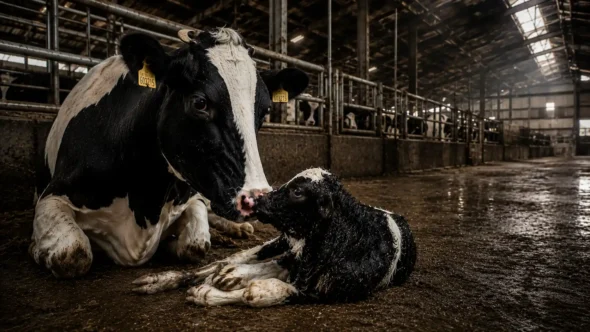
After a nine month
pregnancy, a cow's tiny, teetering calf is separated from her after only
one or two days.
That's how long it
takes for the calf to suckle the disease-preventing colostrum from its
mother but not long enough to snatch the milk which must all be kept
for humans, up to a staggering 7,000 litres a year, ten times more than
her little calf could ever drink. If the calf is a male it is very likely,
after only a week, he will be shot - an unwanted by-product of the dairy
industry. (Before BSE he would have been crammed into a lorry with hundreds
of other calves and despatched on a journey to France or Holland, petrified,
bewildered and often deprived of water, food or rest. On arrival he would
have been placed in a veal crate.)
But what of its mother
cow 324? It was her eighth calf and will probably be the last. The genetic
manipulation and dietary controls which have led to her extraordinary
output of milk carry with them a cost, all borne by the cow. She has
a one-in-three chance of her udders secreting pus and painfully swelling
with mastitis, and the antibiotics forced up her udders don't have much
success in controlling the disease.
Because of the strain
of carrying her oversized udders, she is likely to be amongst the one
third of cows who are lame from foot and leg disorders. And her body
consumes so much energy for milk production that her muscles simply waste
away. From a distance, these skin-covered coat racks, munching grass,
seem to be in an idyll. But the ugly truth is that a quarter of dairy
cows are so exhausted by the process they never see their third year,
despite having a life expectancy of 21 years or more. Most cows are killed
at four to seven years, often pregnant when they die. Their meat is then
used for soup, burgers or processed foods.
Professor John Webster,
Department of Animal Husbandry, Bristol University says:
"The dairy
cow is a supreme example of an overworked mother. She is the hardest
working of all our farm animals and it can be scientifically calculated.
It is equivalent to a jogger who goes out for six to eight hours a
day which is a lunatic pursuit. He states that almost 100 per
cent of cows suffer from laminitis - a disease which causes 'great
pain to the cow' (MAFF). Tissue lining of the foot becomes inflamed
and may lead to ulcers. Professor Webster continues: "To understand
the pain of laminitis it helps to imagine crushing your finger nails
in the door then standing on your fingertips."
In intensive farming,
many cows are kept in "zero-grazing" systems. This means that
they are kept indoors, where they can't follow their natural, very strong
instinct to graze. Grass is brought to them, and they are also given
a high-protein diet to increase their milk yield.
Bulls
to you
There are many different
systems for raising cattle for meat, the least intensive being the suckler
herd. The calf is kept with its mother until weaned and then put on grass
until it is heavy enough to be killed at about two years old.
At the other end of
the spectrum, the most intensive method is where calves are taken from
their mothers at birth and reared in pens on milk replacer and feed pellets.
During the first week of their lives they are usually castrated and have
their horn buds chemically burnt out. In the case of older cows a hot
iron might be used and, theoretically at any rate, an anaesthetic.
To put weight on before
slaughter they are taken to fattening sheds and fed on high quality cereals.
There may be straw bedding but it is becoming common to use slatted concrete
floors on which cattle find it difficult to stand, often resulting in
lameness. Some farms keep up to 8,000 animals this way, cramming them
into sheds to stop them from moving around and "wasting" energy
in keeping warm. They gain weight quickly and are ready for slaughter
at only 11 to 12 months old.
Fishy business
You have
now seen how land animals are treated by humans - as mere commodities
devoid of any feelings. So what of the creatures of the oceans
and rivers? "Oh,
we don't have to worry about them because fish don't feel pain!" A
convenient excuse you may think, ensuring fish are treated as though
they have no right to be on planet Earth and if we continue the way we're
going it won't be long before they aren't.
Eighty to 100 million
tonnes of fish are caught each year, mostly from only five different
groups - herrings, cod, jacks, redfish and mackerel. And to catch these,
all kinds of other creatures suffer. Drift nets up to 40 km long catch
everything in their way including dolphins, porpoises, small whales,
rays, sharks, diving sea birds and species of fish which are not wanted.
Fish that are caught in trawl nets are often crushed to death under the
weight of the catch. The 'debris' which comes out of the net - shell
fish, crabs, starfish and every conceivable type of crawling, swimming,
burrowing creature - is simply shovelled back into the sea, most of it
dead.
Those fish which are
still alive by the time they make it on to the decks of fishing boats
have one of two fates. Either they are allowed to suffocate to death
in an alien environment or they are disembowelled with a gutting knife.
Fish such as plaice will desperately cling to life for hours out of water
and may well be filleted alive.
In an apparent concern
at overfishing, the EU has instigated fish quotas for different species
for each member country. What frequently happens is that once a boat
has reached its quota for, say, cod it continues to fish for haddock.
But as cod and haddock swim together the cod which are caught are simply
returned to the sea - dead from suffocation, crushing or injury. (See
Viva! Guide 9: Planet on a Plate.)
A growing sector is
industrial fishing where "non edible" (to humans that is) species
such as sand eels and ling are caught to produce fish oil or to be turned
into high protein livestock and salmon feed or simply to be used as fertilizer.
The myth that fish
are cold blooded and so can't suffer is difficult to shake off. The term
'cold blooded' isn't even accurate as the animal's temperature varies
according to its surroundings. For example, some cold blooded animals
that live in tropical waters can have higher temperatures than most "warm
blooded" mammals. And neither term has anything to do with the central
nervous system which is responsible for whether a creature can feel pain
or not. Like all vertebrates, the fish nervous system consists of a brain,
a single nerve cord along the back (spinal cord) and nerves which enable
the animal to feel good and bad sensations. Of course fish do feel pain!
Like land animals,
fish are also factory farmed and there are between 1,000 to 1,500 fish
farms in Britain alone that mainly rear trout or salmon.
Up to 20,000 young
salmon are packed into freshwater tanks measuring only between four and
10m in diameter. After a year to 18 months they are taken to loch or
river estuary cages where they are injected with antibiotics to control
diseases. They are then regularly doused with pesticides to kill plagues
of sea lice. Despite this prolific use of chemicals, between 20 and 50
per cent die from diseases such as cancer or pancreas and kidney infections.
Before they are killed
by being cut across the gills with a sharp knife, the fish are starved
of food for two weeks. This is simply because it is less messy to take
out the insides of a fish that has not eaten.
The
Slaughterhouse
If you were from outer
space, your alien brain would so far have been seriously intellectually
challenged but don't worry because there's worse to come! How do you
explain to an alien that humans happily eat meat but refuse to think
about how it gets there - don't want to know how it gets there - because
it upsets them? Most people don't want to work in a slaughterhouse, have
never set foot in one and refuse to listen when you try to tell them
about it. How much business would a restaurant do if, when someone ordered
lamb chops, they were given a very sharp knife and a three-month-old
lamb and told to cut its throat?
It might even remind
you of your Martian children who shut their eyes when frightened because
if they can't see the Klingon they think it doesn't exist. So desperate
are some organisations to keep people's eyes closed that they try to
rubbish charities like Viva!.
As a superior being
you firmly believe that the truth cannot harm a person, only help them
to make the right choices. So here it is!
Stunned
Slaughter, like any
other business, is subject to all the usual business approaches - efficiency,
incentives, cost control and so on. The animals which go through its
doors are units of production and the quicker they're killed the higher
the earnings, the greater the profits. Slaughter becomes production line
just like a car factory.
The pigs, sheep and
cattle arrive in lorries and are unloaded into a series of pens called
the "lairage". Chickens are normally left in their crates to
await their slaughter.
Most animals are killed
by having their throats cut and the rules say that they must first be
stunned - made unconscious - to save them from feeling pain. Well, that's
the theory and it immediately falls flat when it comes to religious slaughter.
The drive for speed and efficiency can also result in the rules being
bent but it is the methods themselves which make a nonsense of this supposedly
humanitarian concern. Different methods are used for different animals.
Some of them are:
Electric tongs are
used on pigs, most sheep and some calves.
An electrified water
bath is used almost exclusively for poultry.
Gas stunning is used
on some pigs and poultry.
The captive bolt is
used on cattle, most calves and some sheep.
Electric
Tongs
The animals are taken
from the lairage to the stunning point either individually or in groups
where they are penned and stunned one by one in front of each other.
The low-voltage tongs
consist of terminals which look a bit like headphones and are attached
to insulated handles - imagine a large pair of garden shears with a round
bit on the end of each blade. The slaughterman clamps the terminals to
the animal's head, hopefully in front of its ears, and triggers an electric
shock which is supposed to render it unconscious. A chain is then placed
around a hind leg and the creature is hoisted into the air where its
throat is cut - called "sticking" - allowing it to bleed to
death - called "bleeding out".
Well, that's the theory
but the stunning lasts for only about 20 seconds and if the slaughterman
is too slow the animal can regain consciousness. This happens quite regularly
according to the Food Research Institute. It found that with sheep, the
time between stunning and sticking was usually more than 30 seconds and
in some cases more than a minute. What this means is that millions of
animals are conscious when their throat is cut.
Productivity has a
bearing as slaughtermen are usually on piece rates, being paid on the
basis of how many animals they kill. To be truly effective the tongs
need to be placed in exactly the right position on the animals head and
held there for at least seven seconds. For the sake of speed this often
doesn't happen. Animals can and do regain consciousness but often don't
show it because one effect of the electric shock can be to induce paralysis
for up to 30 seconds.
The European Union
Veterinary Committee says: "Under commercial conditions, a considerable
proportion of animals are either inadequately stunned or require a second
stun. This is mainly because of poor electrode placements, bad electrical
contacts and long stun-to-stick intervals". (Scientific Veterinary
Committee Animal Welfare Section. 1996. Report on the Slaughter and Killing
of Animals. Directorate-General for Agriculture; European Commission.)
Captive
Bolt Pistol
This little device
is like a pistol but when the trigger is pulled and the cartridge explodes,
instead of firing a bullet it shoots out a metal bolt. The bolt can only
travel 9 cm as it's still attached to the pistol. Cattle to be killed
are driven single file into a roofless metal box one at a time, the pistol
is placed against their forehead and the bolt fired into their brain.
Done properly the animal will immediately lose consciousness but often
it isn't done properly. A bad or hurried aim, a sudden movement from
the animal and the bolt can miss meaning agony inflicting terrible pain
and requiring a second attempt.
Again the method of
killing is to haul the animal up by a back leg and cut its throat.
The reason that animals
are first stunned rather than being killed immediately is to allow their
body to continue to function for a short time, enabling the creature's
heart to pump out its own blood. Bacteria in the blood does cause the
meat to deteriorate but it's now known that it makes no difference to
the amount of blood lost whether the heart is beating or not.
Electrified
Water Bath
Poultry represent the
ultimate in efficiency. They enter the packing stations as living creatures
and leave as wrapped, fresh or frozen table birds or in pies and other
meat products. To feed this efficiency, a carefully planned production
line is organised with lorries laden with crates full of birds arriving
at set times throughout the day.
The chickens and turkeys
have their legs placed in metal shackles and are hung upside down on
a moving conveyor. Many of the chickens will already have broken bones.
For turkeys it is particularly painful because of their weight and no
exceptions are made even for the hugely overweight male breeding birds
which can top 27 kg (about 60 lbs) - as much as an eight or nine-year-old
child. The strain on their usually diseased hip joints is enormous and
painful.
The conveyer belt passes
over an electrified bath and one by one their heads are dragged through
it. Some birds miss the bath by raising their heads and these arrive
at the human throat cutter fully conscious. The larger packing stations
often use mechanical throat cutters and for smaller birds it can mean
that the blade misses their throat and cuts their head while for larger
birds it can mean a cut on the breast. If these failures aren't noticed
it can mean that fully conscious birds are dipped into the scalding tank.
This is a procedure which loosens the feathers and is another stop on
the relentless production line.
The European Union
Veterinary Committee report that they are concerned by this method of
stunning because the wrong size shackles are often used; pre-stun shocks
in turkeys are very high (80%) because their wings hang lower than their
heads and touch the water first; and currents may not be high enough
to kill or lose consciousness. Viva! states in its report on slaughter
that ventral neck cutting is not usually carried out and so birds are
often conscious when they reach the scalding tank. Heads of ducks and
geese in particular may not be immersed in the waterbath at all.
(Scientific Veterinary
Committee Animal Welfare Section. 1996. Report on the Slaughter and Killing
of Animals. Directorate-General for Agriculture; European Commission
and Viva! report on Slaughter 1998.)
Religious Slaughter
(For a fully referenced
report on religious slaughter, see Going for the Kill, Viva! Report on
the Religious (Ritual) Slaughter of Animals, 1998.)
As part of their religious
faith, both British Jews and Muslims have special dispensation from the
usual rules of slaughter. Animals killed to provide their kosher or halal
meat are sent to the knife fully conscious. It can be a slow and laborious
process for a stressed and terrified creature.
For Jewish shechita
slaughter, cattle are placed in an upright pen one at a time; he or she
is pushed forwards so that their head sticks out one end; a plate moves
up from the floor to support the underside of the body and the head is
raised by a chin lift which extends the animal's neck so that his/her
neck can be cut more easily. When the throat has been cut, a side gate
is raised and a hind leg is shackled. The chin-lift and belly plate are
released and the animal is pulled out of the pen by a hoist and moved
to an overhead rail.
The animal is supposed
to be killed instantly by a single cut across the neck, however the reality
is somewhat different as the following description of Viva! footage of
the killing shows:
'The cow's neck is
extended and the head lifted upwards by a chin lift in an upright pen.
The animal's nostrils are flaring, eyes staring and it is salivating.
The slaughterer cuts the cow's throat by slicing across it, backwards
and forwards 13 times. The cow jerks away from the knife as far as it
can and its facial reaction shows pain and great aversion. The cow does
not collapse immediately (the filming ends before it does).....'
A huge problem with
religious slaughter is that millions of animals bleed slowly. Anil et
al say: "It is well recognised that unstunned calves which bleed
poorly can take a long time to die." It takes more than five minutes
for the animals to stop trying to stand normally.
(Anil, M.H. et al 1995.
Welfare of Calves - 2. Increase in Vertebral Artery Blood Flow following
Exsanguination by Neck Sticking and Evaluation of Chest Sticking as an
Alternative Slaughter Method. Meat Science, vol 41, 2, 113-123.)
Professor Donald Broom,
specialist in farm animal behaviour, University of Cambridge says:
"Animals are not
stunned during the Jewish Shechita or the Muslim Halal religious slaughter
procedures. There is a period of consciousness after the throat is cut
which may last for 30 seconds to several minutes during which the animal
must be in great pain and distress. As the heart still beats after stunning
and blood drains from the animal just as effectively whether or not the
animal is stunned there is no logical reason why stunning should not
be carried out before the throat is cut."
(Broom, D.M. & Fraser,
A.F. 1996. Farm Animal Behaviour & Welfare. Bailliere Tindall.)
For Muslim halal slaughter,
sheep and goats are placed on their backs in a metal cradle or simply
hoisted up by a back leg before having their throat slit. Poultry are
held head downwards while their throats are cut.
Hardly surprisingly,
many Muslims and Jews have turned against religious slaughter and eat previously
stunned meat, or even more effective they have become vegetarian.
Imagine once again
you're a visitor to earth from outer space, a creature of higher intellect
and greater perception than humans so you are obviously already a vegetarian.
You find it inconceivable that your earthling friends, now they know
the truth, won't join you in such a necessary and fundamental change.
They could continue to bury their heads in the sand, but what's the point
- it won't go away. There's an old saying - if you can't beat them join
them. In this case, the only way to beat them is not to join them. Join
Viva! instead. It's always here on Earth to help you every step of the
way.
|