|
|
|
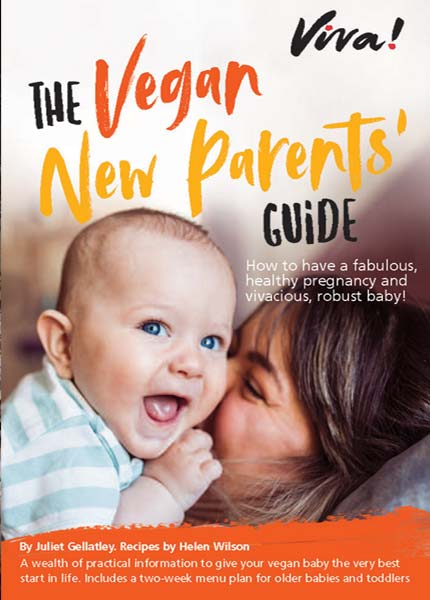
Mother and Baby Guide
Increasing
nutrients pregnancy / Foods & Drink
to Avoid / Importance
of Breastfeeding / Mother
Nature Knows Best / Formula Feeds / Weaning / Four
to Six Months / Six to Eight Months / Eight
to Twelve Months / Survival Tips / Three
Recipes for Baby & You / References
Pregnancy
A vegetarian diet (where
no red meat, poultry, fish or slaughterhouse by-products are eaten) or
vegan diet (where dairy products and eggs are also not eaten) can provide
all the nutrients needed for a healthy pregnancy. Healthy babies are
being born to fourth and fifth generation vegetarians and vegans in the
UK and of course, around the world, whole cultures have been vegetarian
for thousands of years! (See Viva! Guide, Fruits Of The Past, for details
on our vegetarian ancestors). It is the most natural, healthful diet
and perfect for nurturing your unborn child.
A healthy pregnancy
should just be an extension of your normally healthy diet. If you eat
well anyway, then eating right for your unborn child wont be such
a radical change. If, however, your diet has always been based around
junk food, meat and dairy produce, then its time it wasnt!
For both your sakes.
The secret of a healthy
diet is to eat a variety of foods, but focusing on grains, pulses, nuts
and seeds and fresh fruit and vegetables. Dr Michael Klaper, one of Americas
foremost experts on vegetarian and vegan nutrition, has devised a table
(adapted over) which shows what you need to eat each day. Eggs, cows
milk and cheese are high in cholesterol and fat and are not needed for
a healthy diet, so they are not included.There is plenty of scope for
adventurous, creative cookery. With herbs, spices, stock cubes, flavourings
such as soya sauce and creamed coconut, soya cheese and a host of other
extras, you can create the most wonderfully exotic dishes, as well as
all the traditional favourites.
Increasing
your nutrients for pregnancy
During pregnancy, your
daily nutrient requirements increase considerably. Iron, folic acid,
thiamin, niacin, riboflavin as well as vitamins A, C and D, calcium and
protein are all needed in greater amounts. Its not surprising -
youre making a whole new person and youll need more nutrients
than you do normally! If your diet includes plenty of fresh fruit and
vegetables, you will probably be getting more than enough of vitamins
A and C, folate and thiamin, but it doesnt hurt to give them all
a bit of a boost. Heres how ...
Protein
Protein is needed for growth, repair of tissue and protection against infection.
Protein can be found in all pulses (beans of all sorts, peas and lentils),
nuts, seeds, rice, grains and grain products such as breakfast cereals,
bread and pasta. The humble soya bean - used in many soya products such
as soya burgers, soya milk and tofu (soya bean curd) - is nutritionally
equivalent to meat, containing as it does all the building blocks (amino
acids) of protein. Preeclampsia, a syndrome of high blood pressure, reduced
blood flow to the placenta and premature delivery, has been attributed
to insufficient protein intake and so it is prudent to increase your intake
in the final trimester. The good news - medical studies on 775 vegan mothers
showed them to be less prone to preeclampsia (1).
Fats
Fats are essential in the diet for repairing body tissue, to carry some vitamins
(vitamins A, D, E and K) and for manufacturing hormones. Fats can either
be saturated (mainly animal fats) or unsaturated. Whilst we dont
need the saturated kind in our diet we do need the unsaturated type - the
so-called essential fatty acids or polyunsaturated fats. There are two
types of essential fatty acids - omega-3 and omega-6. Omega-3 fats are
found in dark green leafy vegetables like broccoli, some nuts eg walnuts,
some seeds especially linseed (also called flax), soya beans and oils extracted
from these foods. Omega-6 fats are found in seeds such as sunflower and
sesame seeds, corn, some nuts (again walnuts) and again soya beans as well
as the oils extracted from these foods. Most Western diets tend to be high
in the omega-6 fats but not so high in the omega-3 fats. Its a good
idea therefore to make sure you include foods such as linseed, walnuts
and soya beans in your diet. Linseed is available as the oil as well as
the seeds themselves - they make a tasty crunchy topping on salads. Its
also worth alternating between the oils you use in the kitchen - sometimes
using soya and walnut oils in place of the more common corn and sunflower
oils. Walnuts and soya beans are rich in both omega-3 and omega-6 fatty
acids (and in the right proportions that the body needs) so are excellent
foods to incorporate into your diet. There are even some specially formulated
oils that supply both the omega-3 and omega-6 fats in the right proportions
available from most healthfood shops. These oils must be kept refrigerated
and are best used cold.
Calcium
This vital element is needed for the healthy functioning of the nervous system,
blood clotting and bone and tooth formation in both mother and baby. Seeds
(especially sesame), nuts* (especially almonds*), dark green leafy vegetables
and legumes such as beans, lentils, chickpeas and tofu (made from soya
beans) are particularly rich in calcium. Contrary to popular belief drinking
cows milk is no guarantee of strong bones. The Harvard Nurses' Health
Study, took 77,761 women, aged 34 to 59 and followed them for 12 years.
The research found that those who got more calcium from milk actually had
slightly, but significantly, more fractures, than those who drank little
or no milk (2). A 1994 study of elderly men and women in Sydney, Australia
also showed that higher dairy product consumption was associated with increased
fracture risk. Those with the highest dairy product consumption had approximately
double the risk of hip fracture than those with the lowest consumption
(3). (See Viva! Guides Nutrition in a Nutshell and The Healthiest Diet
of All.)
Iron
The need for iron increases during pregnancy because both mother and baby are
busy creating new blood. The best sources are dried fruits such as figs, apricots,
dates and prunes, nuts* and seeds, especially sunflower, pumpkin and sesame
seeds and black treacle. Lentils and other pulses, tofu and soya milk, houmous,
cocoa, fortified breakfast cereals, kidney beans, wheat and wheatgerm, green
leafy vegetables and wholegrains are also useful sources. Because vitamin C
increases the absorption of iron from the food in your body, it is essential
to make sure you are eating plenty of fresh fruit and vegetables. The British
Medical Association states that vegetarians are no more prone to iron-deficiency
anaemia than meat eaters.
Vitamins A, C and
E
Vegetarians and vegans get plenty of vitamin A from eating foods containing
beta-carotene. We convert beta-carotene into vitamin A in our bodies. Beta-carotene
is high in green vegetables (spinach, kale, chard, bok choy etc.) as well as
red and orange vegetables (carrots, yams, sweet potatoes etc).
You'll find high amounts
of vitamin C in kiwi fruit, berries and currants, fresh oranges, grapefruit,
broccoli, spinach, cabbage, strawberries, green peppers and other fruit
and vegetables. It's not in meat. Beta-carotene, vitamins C and E (this
latter vitamin is found in vegetable oils, nuts* and avocado) are anti-oxidants
and help protect you from several diseases including heart disease and
cancer.
A great way to boost
your intake is to buy a juicer. They range in price from about £40
to several hundred but are a great investment because fruit and vegetable
juices are also a wonderful source of many other vitamins, minerals and
trace elements, including iron, calcium, zinc and folic acid. Experiment
with different combinations for a vitamin-packed, energy boosting drink!
The B Vitamins
These vital vitamins comprise B1 (thiamin), B2 (riboflavin), niacin, B6 (pyridoxine),
folic acid and B12 (cobalamin). Vitamins B1, B2, niacin and B6 are all
involved in releasing energy from food and help to aid growth and repair
of the body. They are widely available in wholegrains including wholemeal
bread, brown rice and wholemeal pasta, yeast extracts, pulses (beans, lentils),
nuts, seeds, dark green leafy vegetables, avocados and bananas. Many breakfast
cereals are also fortified with all the B vitamins.
Folic acid is required
for protein synthesis, formation of blood, metabolism of DNA (our genetic
blueprint) and helps prevent neural tube defects in the developing foetus.
It is therefore necessary before conception and during early pregnancy
to help prevent this condition. It is found widely in most vegetables
especially dark green leafy vegetables, nuts, pulses (beans, lentils)
and avocados.
Vitamin B12 (cobalamin)
is required for the maintenance of a healthy nervous system and normal
blood formation. The liver has stores of B12 lasting up to 3 years and
the body is also very efficient at reabsorbing it. Many common foods
are fortified with B12 like fortified breakfast cereals, yeast extracts,
margarines and soya milk. Ensure a daily serving of these types of food.
Vitamins B6, B12 and
folic acid are also necessary for helping to keep the arteries healthy.
Vitamin D
Just 15 minutes of exposure to sunlight on the face and arms is all that is
required by the body to manufacture vitamin D. Vitamin D aids the bodys
absorption of calcium. Because it is stored in the liver, a summer of moderate
sun is normally enough to see us through the winter as well. Fortified
breakfast cereals and margarines can be useful dietary sources if exposure
to sunlight is not practicable.
Foods
and Drinks to Avoid
Approximately 95% of
food poisoning cases are due to meat and dairy products. BSE is still
in cattle - one of the many reasons to not eat any cattle products. For
that reason it is best to avoid them for your own health and for that
of your baby. Remember, he or she will eat what you eat, so think carefully!
Ripened soft cheeses such as Brie and Camembert must be avoided as they
may contain high levels of listeria which, in rare cases, can lead to
listeriosis. This may result in miscarriage, still-birth or severe illness
in the new-born baby. Listeria bacteria has also been found in a very
small number of some cook-chill products. These must be reheated thoroughly
until piping hot.
Eggs should be avoided
as they carry risk of salmonella and contain significant amounts of cholesterol.
Vegetables and salads
should be washed thoroughly to remove any contaminated soil and dirt.
Buying organic will also help to limit the chemicals reaching your unborn
baby.
Caffeine in coffee
and cola has been suspected of leading to birth defects or miscarriages
but studies have proved inconclusive.
Although artificial
sweeteners in food and drink are said to pose no threat, again there
have been concerns regarding these. They cross the placenta and are eliminated
very slowly from the foetal tissues.
Smoking is clearly
bad for you and your baby and is associated with low birth weight and
cot death. Its never too late to give up.
Any prescribed or over-the-counter
medication may prove harmful to the baby, even aspirin, paracetemol and
cold remedies. If you dont really need them, the advice is dont
take them. If you do, consult your doctor.
Avoid eating peanuts
and nuts while pregnant or breastfeeding if you, your partner or a child
in the immediate family come from an atopic family - see starred * Note
under Daily Nutrients Guide section previously and Allergies
section following.
| Mother
Nature Knows Best
Dont
forget that despite all the rules and advice, vegetarian
and vegan women have been producing healthy, beautiful
babies for thousands of years. Trust your body and
mother nature to nurture your unborn baby. We are
a great ape and essentially evolved to thrive on
a vegan diet (see other Viva! Guides, Fruits Of The
Past and The Healthiest Diet Of All). Vegetarianism
is the most natural diet in the world so have a little
faith!
|
|
The
Importance of Breastfeeding
Breastfeeding is certainly
the most natural form of nutrition during the infants first year
of life. Breastmilk is truly miraculous - the perfect food for baby which
not only contains every nutrient needed but antibodies that bolster the
babys immune system. It is impossible to replicate the exact formula
of breastmilk. Neither can a bottle replicate the closeness and skin
contact which a baby gets when feeding from her mother. Besides, breastfeeding
is so much easier and more practical than bottlefeeding. Theres
no sterilising equipment, no buying of milk powder, no heating of milk
during the wee small hours and no chance of forgetting the babys
milk if you go out for the day. Also, if youre patient its
a natural means of losing any extra pounds youve put on during
pregnancy. The World Health Organisation (WHO) now recommends that most
women should exclusively breastfeed their babies for six months. They
conclude that in general this is the healthiest start to life for a baby.
There are many benefits
for the baby too. Asthma, eczema and other allergies can all be triggered
by dairy produce. Digestive problems, ear infections and respiratory
problems have also been linked to the consumption of dairy products by
infants.
Researchers are currently
investigating a link between cows milk and Sudden Infant Death
Syndrome, saying that some cot deaths may be as a result of an allergic
reaction to cows milk. Research at Southampton University has discovered
certain proteins, released during an allergic reaction, in the blood
of babies who have died with no apparent cause. Researcher Dr Andrew
Walls says that cows milk was a promising line of research (4).
The American Academy
of Pediatrics Committee on Nutrition has recommended since 1992 that
cows (and goats) milk should not be given during the first
year of a babys life (5).
All good reasons why
babies should be breastfed wherever possible. Although breastfeeding
is natural there is a knack to it and it is a good idea to prepare yourself
before the birth by reading some of the very good books which are now
available.
The Practicalities
of Breastfeeding
Wash your breasts as usual when you bath or shower but dont use soap
as this can wash away the natural secretions which protect against soreness
when the baby starts to suck. Get used to handling your breasts so that you
dont feel awkward or embarrassed about this when the time comes to start
breastfeeding.
The babys suckling
reflex is at its strongest in the first few hours after birth, so when
your baby is handed to you it is a good idea to put her straight to your
breast. If, however, for some reason you feel you cant do this,
dont worry. Just try again quietly and gently a little later -
perseverance and good support usually lead to success.
Dont wash your
breasts before you feed. Its important to have your baby in the
right position with the head slightly tipped back so that the chin is
close to your breast and the lips are close to your nipple - chest
to chest, chin to breast. Brush her lips with your nipple until
she opens her mouth really wide, almost as if shes going to yawn.
This may take several minutes so be patient. When it does happen, bring
the babys head quickly towards your breast so that she takes not
just your nipple but a good mouthful of breast too.
If she is latched on
properly you will see the jaw bone move as she sucks. If not, slide your
little finger into the corner of her mouth to break the suck action and
try again. It is very important that your baby should have opened her
mouth wide enough and be close enough to you to enable her to take a
large mouthful of breast. This means that your nipple is protected from
friction and will not get sore.
Watch that your breast
is not covering your babys nose, making breathing difficult. Gently
hold back your breast with your fingers if necessary. After your baby
has finished feeding, dry your breasts carefully. If you have problems
with leaking, cover them with breast pads. Some people advise putting
cream on or using a spray but this is not recommended as it interferes
with the delicate balance of natural secretions. Wash your nipples once
a day without soap and keep them dry.
Giving short feeds
as often as your baby will co-operate in the early days will give you
both practice. During these early feeds, your baby is getting not the
milk but the colostrum which protects her from disease and helps her
to excrete the meconium from the bowel. Meconium is a sticky, black waste
product which builds up during the time the baby is in the womb. The
actual milk comes in a few days after birth - this might be the second,
third or fourth day. The milk normally comes in quicker for second and
subsequent babies, but this depends on how much sucking the baby has
been able to do. The more you have been able to feed the baby, the more
your breasts will have been stimulated and the quicker the milk will
come in, although until it does, the colostrum will supply all your babys
needs.
When the milk does
come, you may find that you are really bursting and the process
is rather messy! Giving frequent brief feeds from the beginning will
help to minimise this engorgement. Just keep on feeding your baby completely
on demand and your supply will quickly adjust to your babys needs.
If you find you have so much milk that it gushes out too quickly, making
your baby splutter, you can hold back the milk a little by holding your
breast in your fingers just above the areola and pushing your breast
gently upwards.
In the early days you
might find that milk leaks from your breasts between feeds: even hearing
the cry of a baby can trigger the let down reflex which can
cause this to happen. A breast pad inside your bra helps, as does wearing
darkish tops which do not show up any wet patches too obviously. These
inconveniences pass rapidly as you and your baby get used to breastfeeding.
Your breasts will shrink back to normal size (even though they are producing
large quantities of milk), they will not leak and the whole process will
become smooth, easy and quite delightful - very different from those
early days of adjustment.
After your baby has
finished feeding, hold her up against your shoulder and gently rub or
pat her back until she burps. Make sure that she is straight,
otherwise the wind will not come up. Some babies do not swallow much
air so wont need to burp. Dont worry if nothing happens!
And dont worry if your baby brings up some milk after feeds. This
is quite normal and just means that she has had more than enough. However,
if there is projectile vomiting (where it shoots across the room), you
should consult a doctor as this may indicate a fault in the babys
stomach muscles which can be cured by a small operation.
Have confidence in
your ability to breastfeed and dont give in without a really good
try. There are so many wonderful benefits for both of you and dont
forget ... practice makes perfect!
Mothers Diet
for Perfect Breastfeeding
During breastfeeding, your need for extra vitamins and minerals continues as
in pregnancy but you will also need more niacin, magnesium, phosphorus, zinc
and selenium. Yeast extract, wholemeal bread, wholegrains, some pulses, avocado,
seeds, nuts*, mushrooms, brown rice, bananas, tofu and beansprouts are all
good foods to boost your intake of these vitamins and minerals.
Just include one or
two additional snacks each day made from fresh fruit and vegetables,
nuts, pulses, black treacle, dried fruits, fortified soya products and
yeast extract for high-powered, nutrient-rich feeding.
Your diet as a vegetarian
breastfeeding mum will provide all the nutrients your baby needs. And
there is one less risk to worry about. An American study reported that
of seven chemical contaminants, six were found at markedly lower levels
in the breastmilk of vegetarian women compared to a reference non-vegetarian
group. In fact, the average amounts of three of these chemicals in the
breastmilk of the vegetarians were only 1-2% as high as the average levels
in the reference group (6).
Formula
Feeds
Dont be in too
much of a hurry to give supplementary bottles, something many mothers
do because they doubt their own ability to produce enough milk. Your
body responds to the babys demands so if you start to give bottles,
the baby takes less milk from you which means you produce less and have
to give more bottles. And so it goes on. Breastfeeding is best for babies
and I recommend persevering with breastfeeding if you can. However I
understand that for various good reasons you may need to bottlefeed your
baby and choosing the right feed will naturally be important.
Currently there is
only one completely animal-free soya infant formula on the market suitable
for babies - Farleys Soya Formula from Heinz. (Contact Viva! for
further information). Soya infant formulas are nutritionally complete
and comply with strict UK and EC legislation which specifies the nutritional
composition of these formula feeds. (NEVER give babies normal cows
milk or soya milk).
There has been some
concern over soya-based infant formulas in the media. The main concern
has been the fact that soya beans contain compounds called isoflavones,
or phytoestrogens, which behave like oestrogen, the female hormone. Although
isoflavones are very weak (between 1,000 and 10,000 times weaker than
oestrogen), the soya bean contains high concentrations and so people
eating a lot of soya tend to have high concentrations in their blood.
But does this have an effect on babies?
In adults, isoflavones
do not increase oestrogen levels but actually seem to normalise them.
Most women who eat a westernised high-fat diet have very high oestrogen
levels which may increase the risk of breast cancer. The isoflavones
stop the oestrogen from promoting cell division and may protect against
breast cancer. There have been many scientific papers detailing the anti-cancer
effects of eating soya foods.
The other slight concern
with infant soya formula has been the glucose syrup content and the worry
that this may harm teeth. All infant formulas must comply with standards
laid down by UK Regulations which specify minimum and maximum amounts
of carbohydrate (the bodys main form of energy). The carbohydrate
used cant be lactose (the sugar in cows milk) so an alternative
carbohydrate is used - glucose syrup. Glucose syrup is often confused
with sugars but in fact comes from corn starch and is not the same as
glucose or syrup. It is mainly made up of beneficial complex carbohydrates
(starches) not simple carbohydrates (sugars) which are known to be harmful
to teeth. Tooth decay can be the result of many factors, not only the
presence of sugars in a food or drink. Research has shown that soya infant
formulas are no more likely to cause tooth decay than normal infant milks.
The most important factor appears to be how they are consumed. Any food
or drink containing sugars shouldnt have frequent or prolonged
contact with teeth and trainer cups should be used as soon as your baby
is able to drink this way. Thus if normal weaning practices are adopted,
soya infant formulas should not cause harm to teeth.
Soya infant formulas
have been used for decades - indeed a recent review on this subject in
Nutrition Review (1998) states that for more than 60 years, soya-based
infant formulas have been fed to millions of infants worldwide and studied
in controlled clinical research... Consequently, soya-based infant formulas
continue to be a safe, nutritionally complete feeding option for most
infants (7).
Of course, soya is
not a natural food for babies but then again, nor is cows milk
which is loaded with oestrogens - and not the mild ones derived from
plants but potent oestrogens from another mammal. And we have already
seen the host of illnesses and conditions that may be linked to infants
consuming dairy products.
My personal opinion
is that I would choose soya milk rather than cows milk to feed
my baby and I consider it to be a healthy food for both children and
adults and far superior to cows milk.
Making the Formula
Making up the formula depends on the brand so make sure you read the label
properly. Generally, the method is as follows: wash your hands first and
boil enough water for the number of bottles you intend to make. When boiling
the water empty the kettle and put in fresh water - water that has been
boiled before may have levels of minerals that are too high. Let the water
cool and then put the correct amount in each bottle, using the measure
on the side. Measure the formula using the scoop provided. Dont pack
it down as too much powder can be harmful. Level it off with a knife. Add
the powder to the bottle, screw on the cap and shake to dissolve. Store
the bottle in the fridge but throw any away that is not used after 24 hours.
Some babies like their
formula straight from the fridge, others prefer a bottle warmed in a
bottle warmer, microwave oven or jug of hot water. To give a bottle,
cradle the baby in the crook of your arm so that she is cosy and close
to you. When practical, open your shirt so that she can feel the warmth
of your skin. Gently touch the babys cheek nearest to you and as
she turns towards you pop the teat in her mouth. Make sure you tilt the
bottle well so that the milk fills the teat-end of the bottle and no
air can get in which would give her colic. Pull on the bottle a little
as your baby sucks, to keep up the suction. After your baby has finished
her feed, burp her as described at the end of the breastfeeding
section.
Weaning
Weaning, or getting
your baby to switch from an all-milk diet to one that includes solid
foods, is a process many mothers view with apprehension. I felt like
that myself. If anything, it can be worse for vegan or vegetarian mothers
who may have to deal with anxious comments from family and friends. However,
the weaning process is really very simple and most babies accomplish
it remarkably smoothly. And because a meat-free, dairy-free diet is so
natural, you can be reassured your baby can get all the nutrients needed
for growth and development. One very important point to bear in mind
is that salt should be avoided in foods given to your baby. This is because
at this stage in a babys life the digestive system is not able
to cope with foods high in salt. Do not add salt to foods for your baby
that you cook yourself and always choose no-salt or low-salt varieties
of prepared foods.
Four
to Six Months
At this age you can
give your baby a little fresh, unsweetened fruit juice, diluted half-and-half
with boiled, cooled water. Suitable juices are orange (freshly squeezed,
frozen, or pasteurised, unsweetened from a carton) or apple juice (carton
and fortified with vitamin C, but without other additives). Apple juice
is the best choice if you have any history in your family of allergies
to citrus fruits. Give this fruit juice initially from a teaspoon, in
the middle of the morning or afternoon. As soon as the baby gets used
to taking it in this way, try giving it from a normal cup and not a mug
with a feeder lid - it is an excellent way of introducing the baby to
a cup. Continue with breast or bottlefeeding in the normal way.
Breastmilk supplies
all the babys needs, including vitamin C, for the first six months
of her life. So if the baby is happy and thriving, there is no need to
think about introducing solids until she is six months old. However,
if after four months the baby doesnt seem fully satisfied with
milk, you might try giving a first taste of food - but dont start
before four months old.
The first spoonfuls
are really just to get the baby used to the taste and feel of solid food.
Do not think of them as a real source of nourishment at this stage. The
baby still needs milk feeds for that and the emotional satisfaction of
sucking.
For the first taste
its best to give half a teaspoonful of a fruit or vegetable purée
(see Foods For Weaning and How to Prepare Them). Traditionally, cereals
were always the first solid food given to babies, but these are now advised
against due to the possibility of an allergic reaction when given so
early.
Allergies
Asthma, eczema, rhinitis (recurrent sneezing and watering of the nose), hay-fever
and urticaria (skin rashes) are said to be classical allergies. Many digestive
problems are characteristic of food allergies or intolerances such as bloating
and indigestion. Common vegetarian foods to cause allergies are cows
milk and dairy products, eggs, nuts, some fruits and foods containing gluten
(protein found in wheat). Babies often grow out of allergies, usually by
the time they are three years old, although some, particularly to dairy
products and nuts*, can last a lifetime.
Allergic reactions
are really quite rare and where they do occur, are usually inherited
so you will know in advance if they are likely. Delaying the introduction
of the first solid food until six months makes the risk of an allergic
reaction less likely because the digestive system is more able to cope.
However, no one knows at what age it is safe to introduce allergy-provoking
foods to children. But families that have a susceptibility to allergic
conditions are advised to play safe. If a child suffers from any of the
classical allergies listed above, or if the child has a parent or sibling
with any type of allergy, then the child should not be given peanuts
or peanut products until they are at least three years old (8). When
introducing new foods its a good idea to try the baby on the same
food for several days before introducing another so you can make sure
there is no allergic response. Continue with just one food for at least
four days before trying another, watching carefully for any reaction.
You can gradually increase the quantity so that your baby is having,
perhaps, two tablespoonfuls at a time. This allows the babys digestive
system to slowly adapt.
Give this first taste
of solids at one of the main milk feeds corresponding to breakfast, lunch
or dinner, whichever is the most convenient. If you are planning to go
back to work but want to continue breastfeeding, start giving the solids
at lunchtime as this will eventually become the first meal at which the
baby gives up breastfeeding and has only solids.
Whether you give the
solid food before or after the milk feed is entirely up to you, or perhaps
more to the point, up to the baby! Its generally better to give
solids before the milk feed so you can gradually increase the quantity
until the baby is satisfied and eventually forgets about the milk feed.
However, there is no point in trying to give solid foods if the baby
is hungry and crying, wanting comfort and crying for a feed. Better to
feed first and give solids afterwards.
Use a flat, shallow
spoon and be prepared for the fact that the baby may well spit out your
lovingly prepared offerings. Dont take it personally and dont
worry because the baby is not depending on it for nourishment at this
stage. Try again another day, persisting gently. There is no hurry.
Six
to Eight Months
At six months, iron
stores in infants become depleted and it is important to ensure iron-rich
foods are included in your babys diet. Dark green leafy vegetables,
puréed dried apricots and figs, puréed pulses (such as
lentils and beans) and black treacle are all good sources of iron. The
vitamin C from adding orange juice will increase the absorption of iron.
For babies where allergies are not a problem in the family nuts* are
a very useful addition to their diet and can be introduced from six months
of age, provided they are of a suitable texture - eg smooth nut butters.
Almond and cashew nut butters provide pleasant alternatives to the usual
peanut butter spreads and are available from most healthfood shops.
As your baby takes
more solid food, the demand for milk will decrease. The baby will suck
from you for a shorter time and at around eight months may eventually
give up the milk feed entirely at the meal time. Your milk supply will
decline correspondingly, the reverse of the process that enabled you
to produce enough milk in the early days. You will probably find it takes
two or three days for your body to catch up with the babys decrease
in demand and your breasts may feel rather full, but this transition
period only lasts for a couple of days or so.
You can now begin to
enrich the simple fruit and vegetable purées with vegetarian protein
ingredients. Any of the following can be added:
Orange lentils made
into a thick soup makes a wonderfully nutritious meal for a baby. Serve
it as it is or with a little crustless wholegrain bread mashed into it
or make the soup extra thick and add to a vegetable purée.
Mashed beans such
as soya, red kidney, cannellini or butter beans can be cooked thoroughly
and mashed into a purée. Use home-cooked or canned ones but if
using the latter, ensure they are rinsed properly to remove the salted
water. Dont give canned beans to a baby younger than eight months.
Beans in tomato
sauce makes a nutritious meal from eight months onwards. Choose
a variety without preservatives or colourings and although they will
probably still contain a little sugar and salt, they remain a nutritious
food. Mash or purée them. Can be mixed with crumbled wholegrain
bread and a little boiled water to moisten.
Tofu can be
drained and mashed thoroughly, then mixed with vegetable or fruit purées.
The delicate traditional Chinese-style tofu is preferable to the more
solid widely-available ones.
Fortified yeast
extract can be added 1/4 teaspoon at a time to vegetable purée.
Use a low-sodium (salt) extract.
Brewers yeast (a
debittered one) can be sprinkled sparingly - say 1/4 teaspoonful - over
babys vegetable purée or breakfast muesli mix. It can also
be added to mashed banana-and-soya yoghurt mix.
Finely milled seeds (milled
in a food processor or clean electric coffee grinder or bought ready
ground) can be stirred into fruit or vegetable purées, starting
with 1/2 teaspoonful. If youre grinding your own, use a variety
eg pumpkin and sunflower seeds.
Wheatgerm can
be sprinkled over fruit or vegetable purées, added to cereal mixes
and soya yoghurt for splendid nourishment.
Soya yoghurt -
an active, plain soya yoghurt without preservatives - can be added to
fruit purées or given with a sprinkling of wheatgerm. It can be
mashed with banana and wheatgerm to make a quick baby meal.
Once the baby is taking
these solids happily, you can give an enriched vegetable purée
as a main course, followed by a fruit purée, soya yoghurt or cereal-based
mixture as a pudding. You can also begin introducing solids
before the other main feeds of the day, so that eventually the feeds
that correspond to breakfast, lunch and dinner are composed entirely
of solids. You will also find that as the baby gets used to the texture
of solid food, there is no need to be so particular about puréeing
the food. In fact, it is good for your baby to get used to a bit of texture
in food at this stage. I soon found I only needed to mash food for my
babies, although I have heard of babies who were more fussy.
You will gradually
be able to drop first one milk feed and then another so that by the time
the baby is around nine months, the bedtime feed may well be the only
one left. Do not be in a hurry to wean the baby from the bliss of this;
it is important for the closeness to you and the emotional satisfaction
that sucking gives. Many babies have spontaneously given up on the bedtime
feed by the time they are one year old, but many have not.
There are those who
believe you shouldnt encourage feeding during the night after,
say, six months, when the baby probably doesnt need it for nourishment.
Your baby may just be acquiring an enjoyable habit that may eventually
drive you to distraction. Other child-care experts disagree with this
and my own view is that if a child cries for food and the loving comfort
of his or her mothers closeness, then it is better to meet that
need, even though it can be demanding. But it does pass and, I believe,
contributes very much to the childs emotional security, both at
the time and in later life.
Some people believe
that when you start to give solid food, that is the time to wean a baby
from the breast to the bottle. I dont see any point in this unless
you want to stop breastfeeding. If the baby is happy and all is going
well, it seems better to continue breastfeeding for the few remaining
months. However, once the baby has given up all the daytime feeds, you
might like to give a bottle for the final feed so that you can be free
to go out in the evenings.
At this stage, particularly
if the baby is teething, you can introduce some finger foods. The baby
may find it comforting to chew on something hard: a piece of apple, raw
carrot, bread or rusk, but never leave a baby alone with this type of
food because of the danger of choking. If anything does get stuck in
the babys throat, be ready to hook it out quickly with your finger
or turn the baby upside down and smack gently in the small of the back.
Eight
to Twelve Months
If your baby takes
well to solids, you will quite soon find that she will easily and naturally
eat a little of what you, as a family, are having. Foods to avoid include
sugar, salt, caffeine, deep fried foods, additives and eggs. Eggs must
never be given to under ones, are high in cholesterol and are not
recommended at any age. The main thing to watch is that the babys
portion is not too highly seasoned. Sometimes its possible to take
out a small quantity for the baby before adding spices and seasonings.
If your baby gets used
to trying new flavours, it will make it possible for you to eat out with
friends or in a restaurant. Simply select a suitably unspiced or lightly
seasoned dish from the menu and mash the babys portion with a fork.
At this stage you may
need to consider the amount of fibre (vital in facilitating the passage
of food through the intestines) the baby is getting. If the diet is too
bulky energy intakes can be restricted. Since a vegetarian or vegan diet
is naturally high in fibre, it is important for the baby to have a diet
that is energy dense. This is easily achieved by including foods such
as pulses, vegetable oils, seeds, avocados and smooth nut butters* (if
no likelihood of an allergy - see Allergies section), yeast extract (unsalted),
tahini (sesame seed paste), tofu and soya yoghurt. If the diet becomes
too laxative, it can also cause a very sore bottom. It may be advisable
to give a bread that is lower in fibre than wholegrain. Try wheatgerm
bread or, if this is still too fibrous, get an enriched white one. Try
a higher fibre bread again when the baby is a little older.
Survival
Tips
Dont worry if
your child really does not like some food; you can usually find another
source of the same nutrients. Its better to stick to foods that
you know will go down well and avoid a battle of wills.
All children will go
through the stage when they learn the power of the word no. If this veto
is used over food you may be able to nip it in the bud by offering a
choice of two equally nutritious items instead of one that they can veto.
Encourage your toddler
to feed herself from an early age. Yes, its horribly messy but
a sensible bib - the plastic ones with pockets which catch spilled foods
- are good and some kind of easily washed covering on the floor under
the babys chair will cope with most disasters.
Dont worry if
your toddler eats the foods in the wrong order or mixes things
up (after all, thats part of the fun, spoilsport!) and dont
set too high a standard. The toddler will enjoy being independent and
competence will grow with practice. Youll bless it in the end!
If theres a problem
over food, the secret is not to get emotional about it. It simply isnt
worth making an issue over food or allowing difficult situations to develop.
In fact, as in all things concerning your child, its your relationship
with him or her thats most important. This is what youre
building up and what will endure long after youve forgotten the
horrors of broken nights, food fads and puddles on the carpet! Always
put your relationship first, before a spotless house, before rigid time-tables,
before battles over food and you will be rewarded by the deepening bond
of understanding and companionship that will develop between you.
|
|

Rose Elliot
MBE is Britains foremost vegetarian cookery writer and
her books have won her popular acclaim all over the world.
Her invaluable book, The Vegetarian Mother and Baby Book, explains
the nutritional value of all the basic foods and gives a comprehensive
range of recipes for mother and baby up to the age of two.
The book arose from her personal experience as mother of three
daughters.
Rose has
written many other best sellers including Simply Delicious;
Supreme Vegetarian Cookery; Not just a Load of Old Lentils;
The Bean Book; Complete Vegetarian Cookbook; Vegetarian Slimming
and Vegetarian Express.
Rose has
been in the vanguard of the revolution of our eating habits
in recent years. She is a frequent contributor to national
magazines, as well as giving cookery demonstrations and broadcasts
on radio and TV.

We
now know that what you eat both before and during pregnancy
has a dramatic effect on your babys health not only during
the early years but right through into adulthood. Choosing
a good vegetarian diet is not only safe but can help ensure
that vitamins - such as folic acid, vital for early development
of the foetus - are provided. A well balanced vegetarian or
vegan diet is a fabulous way of feeding babies and young children
too. Childhood asthma is rare in infants who eat plenty of
fruits and vegetables.
Dr Chris Fenn Accredited Nutritionist

Kee Macmillan
Jessi (seven years)
I
have been a vegetarian for most of my life and had no concerns
about my health during my very easy pregnancy, in fact I believe
my balanced veggie diet was a positively helpful factor. Jessi
is now seven and was brought up with a balanced vegetarian diet.
She is a very healthy girl and has developed a taste for healthy
food which many other children dont. Some of her favourite
foods are salads, broccoli, and raisins with plain yoghurt, as
well of course, as chips and pasta.
I breastfed
Jessi until she was about 18 months old and kept her away from
processed and sweetened foods as much as possible until she
was about three years old. I feel this start to her life has
given her a natural favouring towards healthy foods and a disinterest
in a lot of unhealthy foods - by her own choice these days.
I would definitely recommend a balanced vegetarian diet as
a positively healthier way of living and a great start to life
for children, making them healthier and introducing healthy
eating habits which remain with them in the future.

Jane
Lacey
Frances (now five years) and Kira (now three years)
I
have been vegetarian for 10 years and in that time Ive given
birth to two beautiful, happy, healthy girls, Frances (age five)
and Kira (age three). Both pregnancies were remarkably problem-free
and after normal deliveries both children were successfully breastfed
for at least six months. But I thought Id let Frances tell
you why we think veggie is best: I like being veggie
because meat is from animals and I want animals to stay alive.
I like helping mummy grow vegetables in the veg. patch - we grow
tomatoes, spinach and other things and I like to eat the mangetout
straight from the plant. Vegetables have lots of vitamins which
make me and Kira big strong girls.

The
human body has no nutritional requirements for animal flesh
or cows milk. It functions superbly without them, and
this includes producing healthy offspring!... All the protein
and calcium required for human health, including during pregnancy
and childraising, are abundantly available from plant sources.
Michael Klaper MD Author Pregnancy, Children and the
Vegan Diet. Available from Viva!

Wendy
Turner-Webster, TV Presenter (Pet Rescue)
with newly born Jack
After
breastfeeding Jack for three months he went on to soya formula
and has thrived on it ever since! I must say that I could not bear
the thought of putting dead flesh into my babys mouth. Jack
has a colourful and varied diet combining vegetarian foods with
my dairy-free alternatives to margarine, ice-cream, yoghurt, cream
cheese etc. I have heard many times of the parents who are reluctant
to tell their kids where burgers and bacon sandwiches come from.
When Jack is old enough to understand I will have no hesitation
in telling him the truth: the only way surely that anyone can then
be expected to make an informed decision. My pet hate is the way
we are brainwashed from a young age to love some animals and eat
others!

Miranda
Michaelides
Phoebe (now three years)
Throughout
my pregnancy I had no desire to eat meat and the only craving I
had was for carrots! (which incidentally, is now Phoebes
favourite food). My pregnancy was completely normal and I gave
birth to a healthy 8lb 12oz baby girl, bang on the due date! Phoebe
is now three years old and enjoys a wide range of veggie food.
She is perfectly healthy and developing quite normally. I am without
doubt, that a veggie diet is safe for children - in fact, I believe
it to be healthier than any other diet. I have no hesitation in
recommending veggie living to everyone.
Scientific
studies show balanced vegetarian and vegan diets to be not
only perfectly safe during pregnancy and childhood but may
confer significant health advantages over the longer term.
Animal-free diets will no doubt come to be regarded as the
very best health insurance policy a parent can give their offspring.
Laura Scott (MSc Nutrition)
Vegetarian & Vegan Foundation Senior Nutritionist

Lesley
Jeavons
Aidan (now nine months)
Apart
from a few weeks of morning sickness, I had a perfectly wonderful
healthy pregnancy. I felt great and was fit enough to work right
up to my due date!
I thought
that my midwife would give me a hard time for being vegan so
when I went to see her I was armed with facts from the Viva!
Vegetarian and Vegan Mother and Baby Guide. Instead she was
supportive and pleased that I knew about nutrition. She was
also relieved that she didnt have to give me the talk
on danger foods to avoid in pregnancy - all animal based, and
therefore irrelevant to a vegan!
Aidan weighed
7lb 2oz at birth. He is totally healthy and is gaining weight
rapidly. Up until four months his sole food had been breastmilk,
though now we are weaning him, he has a varied healthy diet
and hes taken to it like a duck to water.
Im
convinced that a vegan diet is the most natural and healthy
- for me and my precious baby - and I wouldnt consider
giving Aidan anything less. I wholeheartedly recommend a vegan
diet to anyone. What better natural start could you give your
child?
Fiona
Phillips, GMTV Presenter
Nathaniel (27 months)
As
a healthy vegetarian I enjoyed a perfectly normal pregnancy and
had no concerns about bringing up my baby on a meat-free diet.
Indeed Nathaniel is reaping the benefits that come from being a
veggie. He is developing normally, robustly healthy and without
doubt bigger and bouncier than his peers! And all this without
any animal flesh. This is no surprise to me as I consider a vegetarian
diet to be not only perfectly safe but more healthy for you and
your baby. I would have no hesitation in recommending a vegetarian
diet to everyone!

I
believe the vegan diet to be the healthiest way to eat; it
is therefore of no surprise to me that just such a diet provides
amply for all bodies be they adult, teenage or - the subject
of this unique guide - baby, infant or pregnant ones! An easy
to read source of sensible and accurate information. Following
the advice in this booklet will help to ensure a healthy pregnancy
and robust offspring. I endorse it wholeheartedly!
Dr David Ryde
Fellow of the Royal College of General Practice
There
is no doubt in my mind that a vegan or vegetarian diet is excellent
at any time of life, perhaps especially at the start of life
when the developing foetus is so sensitive to environmental
influences. The only thing it lacks are those nasty things
we find in meat (and especially intensively farmed meat). Women
in pregnancy who want the best diet for themselves, for their
developing baby, and for their young children will find the
Viva! Vegetarian and Vegan Mother and Baby Guide an excellent
and safe guide to healthy vegetarian and vegan food.
Dr Peter Simmons

Kate
Melvin
Hamish & Angus (identical twins, now one year)
Being
vegan yourself is one thing. Other people simply tell you that
you are extreme. Bringing up vegan babies is a whole different
ball game. For some people this is a step too far and you are being
irresponsible by inflicting your beliefs on your children. As a
vegan couple we felt there was no alternative but to bring up our
twins, Hamish and Angus, as vegan.
As a vegan
of 13 years I enjoyed a relaxed and trouble-free pregnancy.
Not only did I stay very active and healthy, but much to the
amazement of the health professionals, I carried our babies
for the full 40 weeks! (unusual for twins). Angus was 6lbs
11oz and Hamish 7lbs 4oz, which for twins is fantastic (the
average is 3lbs).
Hamish and
Angus arrived naturally and were breastfed almost exclusively
until I returned to work at five months and for some feeds
until eight months. Soya formula milk is not difficult to get
hold of and they both thrive on it. At the start of weaning
we used potatoes, vegetables and fruits but the biggest hit,
and still is, was porridge each morning. I gradually introduced
lentils in soups and beans mashed up as well as useful foods
such as ground seaweed, tahini, yeast extract, hazelnut oil,
dried fruits etc. Hamish and Angus will try anything and the
staff at the nursery look forward to trying their exciting
dinners. They have even suggested we write down the recipes!
All babies have their favourites and for Angus and Hamish its
avocado and rice.
I am careful
with their food, as I am more concerned than most parents that
they should be happy, healthy, well developed children. I was
initially worried that I might not be able to provide all the
nourishment they needed but as time goes on I realise they
are fully nourished, energetic boys. Their developmental review
at seven months confirmed that they were advanced for their
age. So I need not have worried and I would have no hesitation
in recommending a vegan diet to anyone. Hamish and Angus are
living proof that a vegan diet is not only perfectly safe but
a healthy alternative to one full of animal proteins and fats.
Sadly everyone
around me is waiting for our children to be ill or under-developed
so their concerns are finally justified. However, with such
strong, intelligent, lively, happy and contented toddlers I
think they will be waiting a long, long time! Indeed the childminder
who looks after Hamish and Angus at nursery - Janet - had this
to say about them and thinks that the twins are as developed
as 15 month old toddlers!: In my 25 years experience
with children I havent seen such strong toddlers! I cannot
believe they are vegan. It must be all the good quality, healthy
food they eat.

Fiona
Smithers-Green
Finley (now six months)
When
my husband and I discussed having a baby, the last thing we worried
about was my diet. I have always been 100% convinced that a vegetarian
diet would pose no problem for conception and pregnancy and I was
right! My son was born a healthy 8lb 13oz and has been thriving
ever since. I have no hesitation in bringing Finley up on a vegetarian
diet, in fact, I would be more worried about his health if his
diet included meat. A veggie diet can supply every nutritional
need perfectly well and I would recommend it to everyone.
|