The L-Plate Vegan
Since you’re reading this guide, you must be either
taking your first faltering steps in veganism, or thinking
about it. Good for you!! Your friends and family have probably
wasted no time in filling your head with ridiculous horror
stories – the extra head you will grow, not to mention
the endless mountains of lentils you will have to eat. But
you know that this is rubbish, don’t you? Don’t
you?! Let me spell it out.
Veganism is…
…good for you. A vegan diet reduces the risk of heart
disease, some cancers, strokes, rheumatoid arthritis, kidney
stones, high blood
pressure, asthma and allergies. It also reduces the chance of you
contracting food poisoning to almost zero. And of course you avoid all those
chemicals, growth promoters and antibiotics that are pumped through the animals.
(Further information in Viva! Guide 7 – Your Health in Your
Hands and Guide 2 – Stop Bugging Me.)
…good for the animals. If you’re already a vegetarian
you’ve undoubtedly helped reduce animal suffering, but
the dairy and egg industries are no picnics for the animals
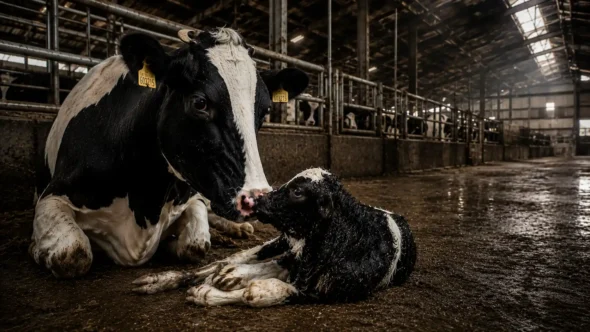
involved. Cows must be repeatedly made pregnant for the production
of milk and their
offspring either killed at one or two days old or reared for veal, beef or
milk. Dairy cows are killed at about five years old for ‘low grade’ products
such as burgers, sausages and meat pies. Naturally, they would live until at
least 20. Each year some 150,000 cows are still pregnant when killed in the
UK. Goats kept for milk are also killed prematurely for goat meat – often
by religious slaughter methods for an ethnic trade.
And as for battery egg production… hens are imprisoned
in cages, row upon row. Since only the females lay eggs, 40
million day-old male chicks are killed every year. And the
label ‘free range’ is no
guarantee that eggs are cruelty-free – large scale commercial production
can mean thousands of hens on the floor of a shed never finding
their way outdoors. The RSPCA Freedom Food symbol sadly approves factory farms
and so is no assurance of hens being genuinely free range. However, eggs marked ‘free
range’ and ‘Approved by the Soil Association’ does mean that
animal welfare standards are higher than the norm (but the male chicks are
still killed). All hens (free range and caged) are killed prematurely – and
made into stock cubes, soups, baby food or pies. (Further information in Viva! Guide
11 – Murder, She Wrote.)
…good for the environment. Forests are destroyed to
farm cattle, as are British woods and hedgerows, resulting
in a loss of habitat for countless species. The soil is poisoned
with chemicals to increase crop production that is destined
for animal feed. The waterways are polluted with livestock
slurry, and cows belching and farting out all that methane
contributes to global warming. (Further information in Viva! Guide
9 – Planet on a Plate.)
…good for the planet’s people. 800 million people
are hungry and there’s no need! We could easily produce
enough food to feed
everyone if only we stopped feeding all the crops to the animals. 100kg of
plant protein produces only 9kg of beef protein or 31kg of milk protein. Doesn’t
it make sense to just eat the plants?! (Further information in Viva! Guide
12 – Feed the World.)
What is a vegan anyway?
So, now you’re convinced that veganism isn’t barmy,
you’ll want to know what it involves, won’t you?
One thing it doesn’t involve is deprivation or martyrdom – there
really is no need to sit around munching your way through a
stack of lettuces and feeling sorry for yourself (unless, of
course, you like lettuces and feeling sorry for
yourself!). Ask any vegan what they eat and they will look at you in astonishment.
The foods available are so varied, so tasty and so easy to prepare, it’s
a miracle that we do anything other than eat! (Truth be told, some of us don’t!)
Now I’m not saying you won’t miss a few things
at first – cheese and chocolate are often the hardest
to kiss goodbye, but there are vegan alternatives available,
so don’t despair. For delicious vegan recipes, see Viva!’s
Guide, Martin Shaw Cooks Veggie (£1.50 inc.
p&p from Viva! – call 0117
944 1000 to order, Mon-Fri).
What’s the difference between a
vegetarian and a vegan?
Well, a vegetarian simply does not eat any dead animals, or
bits of them. So this means no meat, poultry (chicken, turkey
etc), fish or other water creatures (such as prawns and crabs),
or any by-products of these industries, such as gelatine or
animal fats. This means eating only ‘vegetarian’ cheese,
as some cheeses are made using rennet (taken from the stomachs
of calves – yuk!). Many vegetarians will only eat free-range
eggs too, because of the cruelty of the battery system.
A vegan will not eat any of these either, but will also avoid
eggs
(free-range as well as battery) and dairy produce (products made
from cow, goat, sheep or any other animal’s milk). This includes milk,
cream, yoghurts, cheese and anything that contains these products or derivatives
of them.
Honey is also avoided, because bees are frequently killed
during its production. And finally, a vegan will avoid wearing
wool, leather and silk, and using cosmetics or toiletries that
contain animal substances. In fact, a vegan won’t eat
or wear or use anything that comes from any animal, dead or
alive.
Sounds like a lot to remember, huh? To begin with you’ll
be reading every label in the cupboard, looking up things like ‘lanolin’ in
your dictionary and trying to remember why you embarked on
veganism in the first place! But it does get easier and no
one will blame you if you make a mistake. We all do. Just take
things at your own pace. And remember, you’re taking
the biggest, most important step to end the cruelties to farmed
animals, meted out on a daily basis.
Next Section |
|
This is Viva!’s guide
to vegan shopping. For vegan recipes order Martin Shaw
Cooks Veggie (£1.50 inc. p&p), or Snappy Veggie
Cooking (for teens by teens – £1.50 inc. p&p)
and choose from the wide range of recipe books in our free
Books for Life catalogue. Call 0117 944 1000 Mon-Fri or
go to our online shop |
| |
| Eco-Logical |
| Feeding
100kg of plant protein to farmed animals produces only
9kg of beef protein or 31kg of milk protein. Doesn’t
it make sense to just eat the plants in the first place?
|
| |
| Barf-Out! |
The vegan foods now available
are so varied, so tasty and so easy to prepare, it’s a miracle that we
do anything other than eat! (Truth be told, some of us
don’t!)
|
|
Leather Undies...
Nein Danke!
|
Vegans also avoid wearing wool,
leather and silk, and using cosmetics or toiletries that
contain animal substances.
|
|