Life Sentences
An agonised debate wracked society a couple of hundred years ago. Church,
government and the middle classes searched their
consciences, argued publicly and offered
evidence to back their views. However, it was a one-sided argument
and they soon reached agreement, with a collective sigh of relief. It was
official – black people didn’t have souls. More than that,
they would benefit from the discipline of hard labour provided by their
Christian masters.
The outcome was – business as usual. Ship’s architects played
with little models of prostrate humans, jiggling and juggling them until
every available space on every possible deck was filled. They produced
new vessels that could carry even greater numbers of slaves. It translated
into millions of human beings being chained, motionless, side by side in
the festering dark of a ship’s hold for weeks on end. Over two million
died and were simply tossed into the Atlantic’s waves.
In West Africa, slave traders continued to plunder villages, yoking the
inhabitants by the neck in long lines of misery. In the colonies, plantation
owners continued to divide families, beat abuse and exhaust the people
over whom they had complete and total control. In Bristol and other sea
towns, the monied counted their dividends from this trade in human degradation.
So long as we persuaded ourselves that black people were beasts then we
could do to them as we wished. Few people posed the question of whether
we should be handing out such barbarity to beasts. The overriding concern
was to defend the right to make money. In order to do that, almost anything
could be excused.
The argument these days is not about souls but about consciousness, awareness,
the
ability of animals to feel or fear. But it is motivated by entirely
the same morality. Pigs are imprisoned in barren crates, so deprived of
stimulation that they often go mad. They are forced to have as many litters
of piglets as their bodies will stand but they are not allowed to mother
them. But it’s fine because they spend their lives in buildings sheltered
from the elements with all the food they need and no animal wants more
than that! Well, that’s what we’re told.
If a person did the same thing to dogs they would be prosecuted for cruelty – and
yet a pig is equally as intelligent as a dog. So why the difference? Why
do we have two sets of rules, one for a dog and one for a pig? There is
no logical explanation except that we eat pigs after we’ve been cruel
to them and industry makes money from their suffering.
Doesn’t it seem extraordinary that we can cram sheep into lorries
in three tiers,
knowing that the top tier will urinate and defecate on the sheep
below and that tier will do the same to the sheep below them. We then drive
them around Europe without food, water or rest and talk about a humane
society. Could anyone with no financial
interest conceive of such a way to treat any feeling creature? But,
of course, they feel differently to us! Or so we’re told.
Trawlers criss-cross the world’s oceans, their trawl boards crushing
everything on the sea bed that has the misfortune to be in their path.
Much of what is caught is either thrown back dead or turned into fish meal
to feed other animals. Those to be eaten have a knife thrust into them
and are
disembowelled while still alive. But that’s
all right because fish don’t feel pain! Who could ever have conceived
of such an excuse and who would have believed that so many people would
be taken in by it?
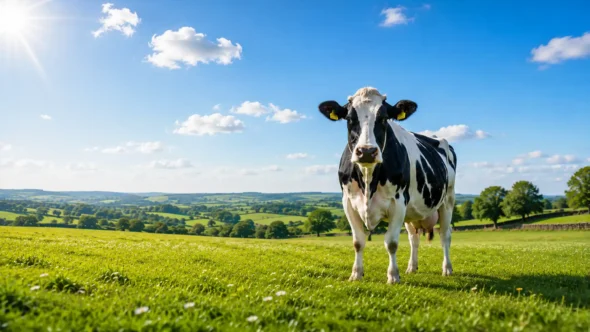
Watch a chicken as she forages around a field. It struts and scratches
and runs and bathes in sand. Its feet thrust the earth to one side in search
of bugs and beetles and seeds and other things to eat. Her feathers shine
and glint in the sunshine. What
intelligence could ever have conceived of taking these restless creatures
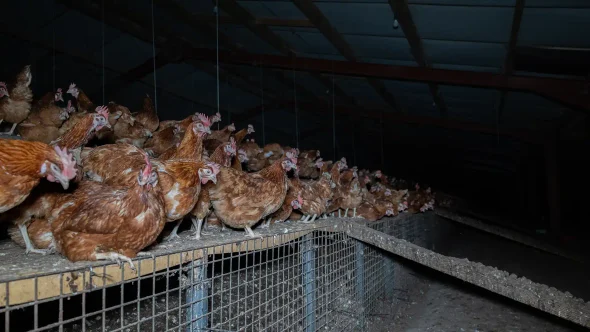
and cramming them five to a cage little bigger than a microwave oven? The
beak is clipped, the feathers fall out and the pathetic creatures are bred
to produce 10 times more eggs than they would naturally. Instead of bugs
and beetles and seeds we produce boring pellets of indeterminate origin
and feed
that to them. Every attempt to end the
battery system is resisted. Well, chickens aren’t really animals,
are they?
The only excuse for visiting such suffering on other creatures can be
ignorance. But that exit is closed to us because we do know the truth.
We might pretend we don’t, we might say that to give up battery eggs
is pointless as one person’s abstinence doesn’t make
any difference and we might even say what the battery owners say – that
it’s of no
consequence. But really we know it’s wrong and that knowledge makes
us push the
reality into the darker reaches of our minds. If we don’t think about
it, it doesn’t exist.
The world has existed for nearly five billion years during which time
various life forms have developed and evolved. From the earliest sea life
to the most complex mammals such as apes, they have all had one thing in
common – they have lived within their
environment, part of it and dependent on it. On the African plains,
a cheetah chases after a Tomson’s gazelle. It has evolved to live
largely on gazelles and it chases because it has no choice – it’s
that or die. Both creatures match each other closely for speed and
turning ability which ensures that it is largely the weak, the old
or the injured who are caught. Similarly a cheetah which is slow
will not survive. This selection process ensures that only the fit
and healthy survive to pass their genes on to their offspring.
Into this fine web of existence came human beings. In evolutionary terms
we have been here for little more than a twinkling of light. But already
we have begun to tear and break the individual strands which go to make
up the web of life. Our entire teaching, both political and religious,
is to place us above and beyond the rules by which all other animals live,
as though they simply don’t apply to us, as though we are not
animals. But the smartest Porsche car, the best stereo system or
the biggest swimming pool can’t alter the fact that we are animals
and we are governed by the same rules which govern all animals. To ignore
these rules is to court disaster. And that is what we are doing – ignoring
the rules.
As a species, we have looked at the world and said that nothing matters
but us. All
the glories and wonders are there to be exploited and if they can’t
be exploited then they count for very little. We destroy without knowing
the long-term effects of such actions. And even when we do know, we continue
to destroy because today is much more important than tomorrow. It is by
today’s achievements, today’s profit margins, today’s
boasts that we are judged.
The very philosophy which has brought the planet teetering to the edge
of destruction is, we are told, the same philosophy which will save us.
Like the practice of bleeding in the 18th century, the cure for our haemorrhage,
they say, is to prize open even wider the
severed arteries of life. Allow those with the power even greater
licence to make money and the cure will be found. Profit is now the global
penicillin and its voracious appetite can never be satisfied.
Profit knows no morality other than to be successful. In pursuit of that
success, humans and other animals are exploited – ever more demanded
of them. Knowledge, truth and understanding have ceased to be signposts
to the future and have become obstacles to be circumvented. For instance,
we know that smoking is the biggest avoidable killer yet every high street
is littered with discarded cigarette packets. We know that a vegetarian
diet is much healthier than a meat-based diet but it is the livestock farmer
who receives the subsidies. We know that poverty destroys people but the
gap between rich and poor grows ever wider.
Leaders have always refused to accept responsibility for their actions
but lack of integrity has become an epidemic disease. They pass the blame
for their failures down the line – to single parents, to students,
to travellers, to squatters, to immigrants, to other nationalities. Part
of the process is to stereotype each of these groups so they cease to be
a collection of ordinary humans.
So what has this to do with animals? Everything! It is all part of the
same process of denial. By pretending that animals have no real desire
for freedom, to procreate
naturally, to mother their young or even to experience pleasure by
lying in the sun, then it is so much easier to use them purely as commodities – like
so much iron or coal or steel – and ignore their pain and fear. It
is a philosophy which similarly applies to humans.
In the poorer parts of the world we ignore suffering on a massive scale
and in the process conveniently forget our own history of colonisation.
It was they who provided the wealth which we now squander and in return
we destroyed their agriculture and social fabric. We now hand out a few
paltry pounds and pretend that we are helping
to cure the problem which we were instrumental in creating. We still
control their economies and demand fodder for livestock while their children
die from hunger.
Despite the disproportionate volume of the world’s wealth which
we control, we are seemingly incapable or unwilling to solve the problems
of poverty and inequality – even on our own doorstep. When care and
concern for our own species is so stintingly
withheld, what hope is there for animals?
If you refuse to accept this morality of self interest and violence, which
binds this all together, and choose to exercise your right to protest – you
will almost certainly be
portrayed as the violent one. New laws can be used to prevent even
the most peaceful demonstration and so collective action against the violence
of factory farming
or fox hunting can now be prevented,
allowing the perpetrators of the real
violence to continue unhindered.
We, as humans, obviously believe we have the right to determine everything,
who and what shall live and die. We slaughter owls, hawks, crows and magpies
so that grouse or pheasants can be reared in large numbers. We then slaughter
them by sending lead shot ripping through their flesh – and call
it sport. We destroy rabbits as vermin and then demonise the foxes who
live on them.
We then hunt the foxes. We gas badgers because they might have TB;
we trap and kill rooks because we don’t like their habits; chase
hares with dogs for entertainment;
do anything we like to rats and mice; shoot pigeons in their tens
of thousands. We
determine which animals we will eat and deny them everything, we
determine which will be labelled vermin and try to annihilate them; we
allow others into our homes.
Across the globe we destroy whales for cultural reasons, dolphins and
seals because they dare to eat the same food as us; and there is
hardly a species which will not be exterminated if their interests
and ours collide.
It seems we are incapable of understanding that every living creature
has its part to play in maintaining the glorious fabric of our wonderful
world. We pretend that only we can maintain the balance by determining
what shall live and what shall die. It seems we never stop and look around
us to witness the appalling mess we have made – deluding ourselves
that we know what we are doing. None of the animals which we slaughter,
even those we demonise as vermin, pose any threat to the survival of the
planet. It is not they which threaten its existence but us. In this maniacal
juggling act we have begun to drop the balls.
The only hope we have is to fundamentally reassess our role in things
and our attitude to the planet and living creatures who share it with us.
When a calf is dragged into the killing pen, wide-eyed and terrified with
the stench of blood and death in his nostrils, there is no compassion.
Nor when the
captive bolt shatters his forehead. When
the slaughter’s hand grabs the muzzle of a lamb to stifle her bleating
and applies the knife to her throat, there is no compassion. And without
compassion there is little hope for any of us.
Make no mistake, becoming a vegetarian is an important act. Instantly,
you are no longer a part of this insanity. You are no longer responsible
for most of the daily
cruelties handed out to farm animals. You are taking the first step
in allowing the
planet to heal itself but it is much more than that. It is a political
act and a clear expression of a belief is a different way of doing things,
a different kind of world – a better world.
|