|
How Now, Mad Cow?
What
is BSE and how did it start? / What
does it do? / What's
the connection between BSE and CJD? / How
widespread is BSE? / Can you destroy
BSE? / Is BSE a danger to humans? / What
was the Government's Reaction? / What
action was taken? / The feed ban. / Other
species catch BSE. / The Truth at
Last / How many humans are
at risk? / Is beef safe now? / Is
Milk Safe? / How
reliable is the Government's Science? / What
Next? / Animals infected by
BSE / Chronology
What
is BSE and how did it start?
BSE, better known as
mad cow disease, stands for Bovine Spongiform Encephalopathy, an infectious
and incurable disease which slowly attacks the brain and nervous system
of cattle. Spongiform encephalopathies are nothing new and are not confined
to cattle. Scrapie, the form of the disease found in sheep, has been
common in Britain for the past 200 years and a human version, Kuru, was
once epidemic in tribal New Guinea. In the 1920s, another human version
was identified in Western Europe and was called Creutzfeldt-Jakob Disease
(CJD).
The first officially
confirmed cases of BSE were reported in late 1986 but it is believed
that it may have occurred in Hampshire in 1985 and its exact origins
are not known. BSE is caused by a mystery 'infectious agent' which is
neither a virus nor a bacteria and current theory is that it is something
called a 'prion'. No one has ever seen a prion, even under the most powerful
microscope. It defies all the most basic rules of biology and any method
of dealing with it lies at the very limits of present day science.
What
does it do?
The period between
becoming infected and showing symptoms for spongiform encephalopathies
is usually long in relation to the life span of the animal. For example,
Kuru in humans can take as long as 30 years to show itself but once established
it rapidly causes dementia and death. Post mortems show the brain to
be sponge-like and full of holes, hence the name 'spongiform'.
It is a horrible disease
and in cattle, the first signs occur when the cow is put under any stress.
Movement to a milking parlour might induce fear and panic and she may
stand away from the rest of the herd, holding her head awkwardly. Milk
production may drop and she usually loses a lot of weight.
Muscle wastage shows
itself in twitching, quivering and shaking and the cow over-reacts to
touch and becomes very jumpy. Eventually, she will shake violently, stagger
and in the end be completely unable to stand up. The only way the disease
can be confirmed is to remove the head after slaughter, cut it open and
examine the brain. Both it and the rest of the body is then destroyed.
What's
the connection between BSE and CJD?
Scrapie, BSE, Kuru
and CJD are all spongiform encephalopathies capable of jumping from one
species to another. For example, a sheep injected with tissue from a
person suffering from CJD will die of scrapie. It seems that scrapie
in sheep, BSE in cattle and CJD in humans are one and the same disease.
The latest evidence shows that certainly BSE and CJD are the same.
How
widespread is BSE?
By late 1997, the disease
had been identified in over 167,000 animals and in over half of all cattle
herds in Britain. New cases were being reported at the rate of about
300 per month. Some scientists including myself believe that, from the
very beginning, the problem should have been tackled by destroying all
herds with cattle likely to be incubating the disease.
BSE has affected all
breeds of cattle including, significantly, Jerseys and Guernseys on their
respective islands. The black and white Friesian Holstein dairy cows
are the most common victims simply because there are far more of them
in Britain. The youngest case of a cow showing the symptoms of BSE so
far recorded was been 20 months, the oldest 18 years.
The cattle industry
in Britain is under constant pressure to produce more milk and dairy
products at the lowest possible cost because, they say, we the public
demand it. It may be true but the price of our daily pinta is paid for
dearly by the suffering animal. To provide as much milk as possible,
cows are fed protein-rich, concentrated food which, until it was banned,
included the rendered down remains of dead cows and other animals.
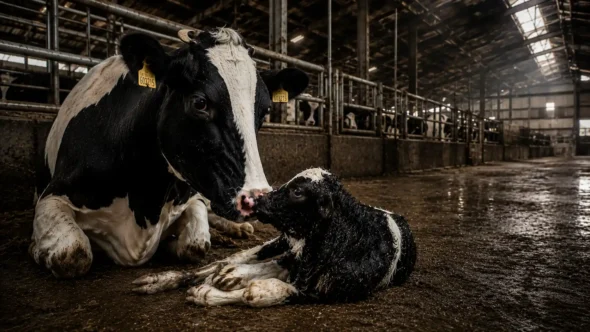
A cow only produces
milk when she has a calf and shortly after birth, her calf is removed
so humans can have her entire milk output. After three months she will
be impregnated again, usually by artificial insemination, giving birth
nine months later. During this time she faces the dual burden of pregnancy
and milk giving. Such stress is unsustainable and after only three or
four pregnancies her body begins to break down and she is slaughtered,
usually at about six or seven years old when she could live well into
her twenties. Almost the entire carcass is used - for burgers, sausages,
pies, stocks and pet food. Until 1989 when it was banned, it included
the brain and other 'specified offal' - spinal cord, thymus, spleen,
tonsils and intestines.
More than 90 per cent
of BSE cases have been in dairy cows rather than beef cattle as these
cows are allowed to live longer - beef animals are slaughtered at two
or three years old, veal calves at six months. The long incubation period
for BSE ensures that most beef animals are slaughtered and eaten before
they are old enough to show the symptoms, even though they may be infected.
Some of the same feed
given to British animals has been exported to other countries and there
have been outbreaks of BSE in France, Holland, Switzerland, Germany,
Ireland, Oman, Falkland Islands, Denmark, Portugal, Canada and Italy,
although on nothing like the scale of Britain.
Can
you destroy BSE?
Although infected carcasses
are now supposed to be incinerated, tens of thousands have already been
buried on farms or dumped in landfill sites. As the BSE agent is extremely
persistent, it can remain active even after years in the soil. According
to Dr Stephen Dealler, there is some evidence that it can even survive
incineration.
Some parts of the cow
carry greater infectivity than others and when cattle are killed for
food, the brain, spinal cord, spleen, thymus, tonsils and intestines
('specified offal') are removed. The Government insists that people are
not at risk when they eat the remaining parts of the animals. It is a
claim based more on hope than science.
Is
BSE a danger to humans?
Despite years of denial,
in 1996 the Government was eventually forced to admit that it is. However,
it maintains that any risk is 'remote' and following the regulations
it introduced in 1989, it now insists that beef is 'perfectly safe to
eat'. Again it is a triumph of hope over science. Having finally been
forced into making the admission that humans can catch BSE, ten years
after it was first identified, the Government's record can clearly been
seen as having placed the survival of the meat industry above concerns
for human health.
We have known for years
that humans can catch a form of BSE by eating infected food - that's
clear from studies of the Fore tribe of Papua New Guinea. Cannibalism,
especially amongst women hoping to increase their fertility, was common
until very recently. In some villages, up to 80 per cent of these women
died from a spongiform disease called kuru. It was first thought that
kuru was inherited genetically but it has now been shown that it is an
infection caused by eating the brains of dead relatives.
What we now have in
Britain is essentially a new form of kuru which is showing similar symptoms
- loss of co-ordination, memory loss and slurred speech eventually developing
into muscle twitching, stumbling and falling over. Once the symptoms
show themselves they advance rapidly and over a period of weeks the person
becomes depressed, confused and unaware, unable to read or recognise
even close relatives.
Towards the end, the
patient is unconscious and often has fits or jerking spasms, is doubly
incontinent, blind, deaf and speechless. Death usually comes about through
lung or other infections.
When a post mortem
is carried out, extreme care has to be taken because the disease is highly
infectious. Pathologist wear a mask, goggles, gloves, boots and a plastic
apron and any instruments have to be thoroughly sterilised. For example,
the silver needles used for the EEG (brain examination) must be treated
with high pressure steam for prolonged periods of time or put through
six successive heat cycles in a sterilizer. Even then there is no guarantee
of destroying the infection. If contaminated instruments are used on
another patient, the disease can, and indeed has been, transferred.
CJD is so feared by
some people in the medical profession that they have refused to perform
post mortems where CJD is suspected. Some hospitals have even refused
to admit patients suffering from it.
What
was the Government's Reaction?
Deceit! It obscured
the facts and fiddled the evidence at every stage of the investigation
It has told expert scientists, including it's own advisors, to keep quiet
in case the hugely profitable meat industry suffers.
In May 1988, the Government
set up The Southwood Committee to examine the risks to both animal and
human health. Extraordinarily, it had no experts on spongiform encephalopathies
and none was consulted. Although experts in their own areas, none of
the members of the Southwood Committee had done any research into spongiform
diseases.
A month after the first
meeting, the Government, on the advice of the committee, ordered the
compulsory slaughter and destruction of carcasses of all affected cattle.
It was already too late. Between the date of the first known case of
BSE in late 1986 and the middle of 1988, at least 600 obviously diseased
cows (plus an unknown amount of animals not yet obviously ill) had been
slaughtered and their meat had found its way onto supermarket shelves.
Half the normal price of carcasses was paid in compensation, which encouraged
farmers not to report suspected cattle. The real extent of the problem
remained unknown.
The second recommendation
of the Southwood Committee was to set up another committee - the Tyrell
Committee - to do more research, admitting that the problem was too big
for it. The next meeting of the committee was five months later - some
indication of how seriously the Government regarded the problem.
Its report admitted
that spongiform encephalopathies were a danger to humans and stated: "With
the very long incubation period it may be a decade or more before complete
reassurance can be given." Quite extraordinarily, the Southwood
Committee went on to say that ingestion (eating) was low down on the
list of possible routes for infection. They were suggesting one rule
for cattle and another for humans.
Two other conclusions
of the Southwood Report were that there was no vertical transmission
of BSE (from mother to calf) and that cattle would prove to be a 'dead-end
host' - the disease would stop at cows and not infect other species.
This introduced the revolutionary biological concept of a non-infectious
infection. Of course it turned out that cattle were not a dead-end host
and there is vertical transmission. The report went on to say: "...if
our assessment of these likelihood's (of possible human infection) are
incorrect, the implications would be extremely serious." Their assessments
have been shown to be incorrect and we do have a potential crisis on
our hands.
What
action was taken?
The Government's lack
of concern for human safety was evident by its response to the Tyrrell
Committee's report. It said that the brains of all cattle sent for slaughter
should be checked to see if they had BSE even if they had no symptoms.
This was not done on the grounds that it was 'too expensive' - too expensive
for the meat industry, that is.
The report also recommended,
as a matter of urgency, the monitoring of all UK cases of CJD for the
next 20 years in order to reassure the public that there was no link
with BSE. 'Monitoring' currently means that a researcher checks death
certificates for CJD. That's it as far as the UK Department of Health
is concerned and CJD is not even a notifiable disease - health authorities
are not required to notify the government when they have a case of CJD
in their area. Of course, a real investigation was never considered and
has never taken place because it would show that the Government was frightened
of admitting to a major public health problem.
The report finished
by saying that more research was needed and that controls to prevent
the disease from spreading were not strict enough. Overall, the report
was an excellent analysis of the situation as it was in 1989 but many
of the proposals it made were ignored. Dated June 1989, it was not released
until January 9 1990, again showing Government's lack of urgency. By
this time they had accepted, although not publicly, that they did not
know whether the disease could pass from cow to calf, whether it was
possible other species could get BSE or whether an increase in sheep
scrapie was the cause of the rise in BSE cases.
The
feed ban.
As part of the cannibalistic
merry-go-round that is an economically essential part of the meat industry,
all the bits of animals from slaughterhouses unsuitable for human consumption
are boiled up to produce fat and protein. The protein goes into animal
feed. Apart from the obvious high risk of infections being passed on,
it seems strange that nobody questioned the biological sense of forcing
naturally vegetarian animals to become carnivores. Sheep brains were
included in cattle feed and this is probably how cattle developed BSE.
In June 1988, the government
imposed a six-month ban on feeding animal protein to cows and sheep.
In December 1988, the ban was extended and laws stopped the sale of milk
from cattle suspected of having BSE. However, banning infected feed did
not stop the rise of BSE. Cases rose from 500 per month in January 1989
to 900 per month in December 1989.
Traces left behind
by the 'mysterious agent' that causes spongiform encephalopathies have
been found in many of the organs and tissues of animals. For example,
cells from offal on the banned list enter the blood and find their way
to many organs, including the liver and bones. The bones of cows are
one of the main sources of the protein gelatine used in many foods -
from peppermints to pork pies. It could present a particularly potent
risk as the procedures used to concentrate gelatine might also concentrate
the infection. As mothers can pass BSE on to their calves, probably through
their blood, cattle blood could also be a carrier.
Despite all assurances,
BSE did not go away. The monthly number of cases rose from 800 in January
1990 to 1,500 in December 1990. The Southwood Committee had predicted
a maximum of 400 cases per month.
Other
species catch BSE.
After four years of
denying it, in February 1990 the Government was faced with proof that
BSE could be passed to other species. Mice developed it after being fed
infected meat. In May of the same year, a domestic cat died from a spongiform
encephalopathy. Even then the Government stuck to its guns and denied
BSE could jump species. By July 1990, when 52 other cats had died, the
Government finally admitted that they had contracted the disease through
eating pet food. The question was no longer whether BSE could affect
other species but how many.
The following year,
BSE was transmitted experimentally to seven out of eight species of mammal,
including pigs and marmoset monkeys and in four experiments, this was
by eating. A puma and a cheetah were also reported to have died of the
disease. Evidence was mounting of an uncontrollable epidemic, with serious
implications for humans.
When CJD, the human
form of BSE, claimed the lives of two dairy farmers who had tended herds
with BSE infected cattle, there was a feeling of inevitability. When
Vicky Rimmer, a 15 year old Welsh girl, developed the symptoms of CJD,
a disease which normally affects elderly people, there was a general
feeling of shock. It wasn't helped when a doctor from the CJD surveillance
unit examined Vicky and told her mother not to make her daughter's case
public. According to the Daily Mirror (January 25, 1994) he told her
she should think of the economy and the Common Market. It seemed certain
that humans were another species which could catch CJD.
Finally, in April 1994,
Government admitted that cows did pass BSE on to their calves and then
later denied it!
The
Truth at Last
The Tyrell Committee
became the Spongiform Encephalopathy Advisory Committee (SEAC) and when
it announced in March 1996 that a new form of CJD - nvCJD (new variant)
had been identified and its most likely source was infected beef, it
detonated a bomb, the sounds of which reverberated around the world.
The symptoms and pathology
(the effect it has on the body) of this new human disease exactly mirror
those of cattle suffering from BSE. Alarmingly, the 17 people identified
with this new strain of CJD had an average age of 27 years. A disease
once associated largely with old people has become a killer of young
people.
The Government's first
reaction was again less than honest. It claimed it relied entirely on
science and every action (or lack of it) had been taken on this basis.
However, science can be manipulated. The scientists appointed to SEAC
by the Government were those who had never voiced any concerns about
BSE. And to begin with, not even public health experts were asked for
an opinion. It was a case of the Government ensuring it got the results
it wanted.
How
many humans are at risk?
No one knows for sure.
However the science is now quite clear that humans can contract CJD from
eating beef. If there had previously been any doubt, it was removed in
October 1996 when scientists at St Mary's Hospital, London, issued a
report showing that traces left behind by the distinctive protein which
causes BSE was also present in nvCJD cases. It was the final fingerprint
in the mystery.
Government had already
been made to squirm in June of the same year when they were forced to
admit that there tests had shown that BSE could be passed from cow to
calf. It raised the prospect that the infective agent was present in
the blood. The only question now remaining is how many people will die.
The government simply refuses to acknowledge it has made mistakes and
will not make any prediction about the size of a possible epidemic.
Dr. Stephen Dealler
puts the potential for human deaths at about 250,000 but admits it could
be anywhere between 1,000 and 10 million. My own worst case scenario
is 500,000 deaths annually for many years.
Is
beef safe now?
Having banned certain
offal in 1989 and supposedly introduced new handling schemes for abattoirs,
the Government has consistently claimed that beef is perfectly safe to
eat. The truth is they don't know. 1) They have no idea how strong the "species
barrier" is between cattle and humans. 2) They do not know the effects
of long-term exposure to low doses of BSE. 3) They don't know if the
infectivity is distributed evenly through the same tissue. 4) They do
not know how long it takes for people to become infected. 5) And they
do not know if there is such a thing as a safe dose. SEAC admits all
this.
It is now beyond doubt
that infected cows have low doses of the infection in all parts of their
body - the peripheral nerves and possibly also in the blood. And it is
beyond doubt that infected cattle are still being eaten. The Government's
own secret papers reveal that for every cow diagnosed with BSE and removed
from the food chain, two other infected animals are eaten.
In1990, a trading standards
officer revealed that infected cattle were still entering the food chain
because farmers were failing to report them. It was a result of the Government
offering only 50 per cent compensation. When compensation was later increased
to 100 per cent, there was a flood of reported cases. The slaughterhouse
regulations were also not working. In September 1995, the State Veterinary
Service made visits to 193 slaughterhouses and found regulations were
being ignored in almost half of them. In October, a further 153 visits
revealed failings in one third.
There has also been
widespread flouting of the herd controls with farmers obtaining false
certificates declaring their herds are BSE free when if fact they have
had infections. Other farmers have sold infected cattle on to special
dealers and again have claimed that their herds are BSE free when they
are not. Viva! also established that prior to the current ban on live
exports, controls were being ignored and upwards of 75,000 calves from
infected herds were being shipped abroad each year, some of which were
grown on to maturity. This helped to ensure that BSE was spread across
continental Europe.
Having supposedly banned
the use of feed containing the remains of other animals for ruminants
in 1989, it was still in use for pigs and chickens up until March 1996.
Bone meal, blood and offal was also still in use up to this date and
was spread on fields as fertiliser. The Government's own scientists fear
that this practice may have infected our rivers and water supply.
Also in 1996, in another
completely inexplicable decision, Government announced the banning of
bone meal for commercial use on fields used by ruminants but still allows
it to be used in domestic gardens. The logic is obvious - humans cannot
catch the disease, only cattle. Viva! has called for a complete ban on
all bone meal.
Is
Milk Safe?
This is an area of
concern for many people. Dairy products are supposed to be free of the
cells which carry the infection and in theory should be safe for human
consumption. However, there is the problem of mastitis in dairy cows
which affects about 30 per cent of the herd. It is probable that puss
from the swollen udders could enter the milk supply but is unlikely to
be present in sufficient quantity to present a risk.
How
reliable is the Government's Science?
From the start of the
outbreak the Government has been careful to ignore any science which
did not support its claim that beef is safe to eat. It maintained that
tests with mice showed there was no risk from prime muscle meat. Had
they looked at mink instead they would have found they did developed
BSE after being injected with muscle meat, lung and sciatic nerve tissue
- all still being eaten by humans.
Had they looked at
research from the Institute of Animal Health they would have found that
BSE is most easily caught when infected meat comes into contact with
open wounds - as much as 1000 times more potent.. This could provide
the answer to why nvCJD victims are so young. hen milk teeth are lost,
bloody cavities are left behind and come into contact with the food that's
eaten. Equally, small stomach haemorrhages are common in many young people
as a reaction to dairy products. What better vectors could there be?
What
Next?
It is now too late
for the government, or anyone else, to launch any widespread studies
into the dangers faced by the human population. The biggest study in
the history of the human race is already underway. We can expect to see
an increasing number of deaths of young people, the actual number providing
a clue as to the future progress of the disease.
From the beginning,
every claim made by Government has been wrong, they have selectively
quoted from the scientists and have used animal experimentation to cloud
the facts. It is one of the most cynical exercises in modern politics.
Just days before the 1997 general election it came to light that another
report on BSE had been suppressed for six years -one showing that dogs
were susceptible to the disease.
The survival of one
industry - the meat and dairy industry - has been placed above human
life, possibly millions of humans lives. It is nothing short of criminal
deceit and those responsible should be called to account.
Animals
infected by BSE
Nyala / Gemsbok / Arabian
Oryx / Greater Kudu / Eland / Mouse / Cat / Pig / Marmoset Monkey / Moufflon
/ Puma / Cheetah / Sheep / Goat / Scimitar Horned Oryx / Mink / Ocelot
/ Ostrich
Chronology
November 1986 - First
cases of BSE in cows confirmed
August 8, 1988 - slaughter of cattle begins. Compensation only 50%. Ban on
exporting SBO to EC.
June 21, 1989 - farmers required to notify any BSE cases.
July 18, 1989 - ruminant feed ban introduced.
February 14, 1990 - compensation increased to 100%.
July 10, 1991 - ban on export of SBO to any country.
November 6, 1991 - ban on SBO in fertiliser.
May 14, 1992 - EC bans trade in suspect bovine embryos.
January 21, 1994 - compensation for infected cattle reduced.
June 27, 1994 - EC stops feeding animal protein to cattle.
March 27, 1996 - export ban on UK been imposed.
April 29, 1996 - over 30 month slaughter scheme introduced.
|